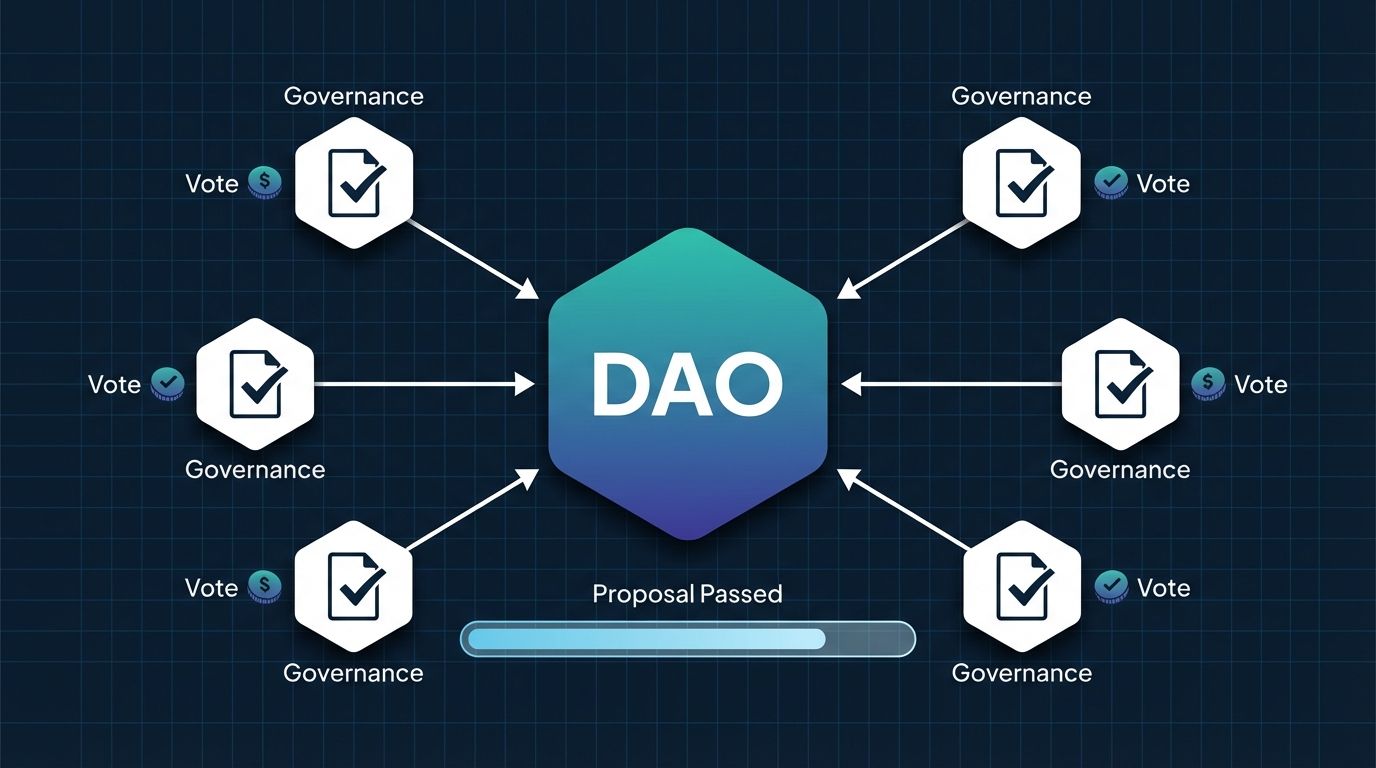

Decentralized Autonomous Organizations, commonly known as DAOs, are reshaping the way decisions get made in the crypto world. Instead of relying on a board of directors or a single CEO, DAOs use smart contracts and token-based voting to put governance power directly in the hands of community members. If you hold a governance token, you hold a real vote on the future direction of a protocol, treasury, or project.
DAO crypto governance has moved well beyond its experimental phase. Protocols managing billions of dollars in assets are now governed by on-chain voting systems where any token holder can submit a proposal, debate it publicly, and cast a binding vote. Understanding how this system works, what types of DAOs exist, and how to participate gives any crypto participant a genuine edge in navigating the decentralized landscape.
1. What Is a DAO in Crypto
A Decentralized Autonomous Organization is an entity governed by rules encoded as smart contracts on a blockchain. There is no central authority. Governance decisions are made collectively by token holders, and the outcomes are executed automatically by the smart contract code once a vote passes.
The core idea is simple: replace traditional organizational hierarchies with transparent, programmable rules. Every governance action, from adjusting protocol fees to allocating treasury funds, is recorded permanently on-chain. Anyone can audit the entire governance history of a DAO at any time.
Key Characteristics of a DAO
- On-chain rules: The operating rules of the DAO are written into smart contracts. They cannot be changed unilaterally by any single person.
- Token-based membership: Participation in governance is typically tied to holding the DAO's native governance token. The more tokens you hold, the more voting weight you carry.
- Transparent treasury: DAO funds are held in a multi-signature wallet or smart contract that requires community approval for spending. Every transaction is publicly visible on the blockchain.
- Permissionless participation: Anyone who acquires governance tokens can participate, regardless of geography, employment status, or identity.
The term "autonomous" in DAO refers to the self-executing nature of smart contracts. When a vote passes and all conditions are met, the approved action executes without requiring a human intermediary to carry it out. This removes a layer of trust that traditional organizations require from their members.
2. How DAO Governance Works
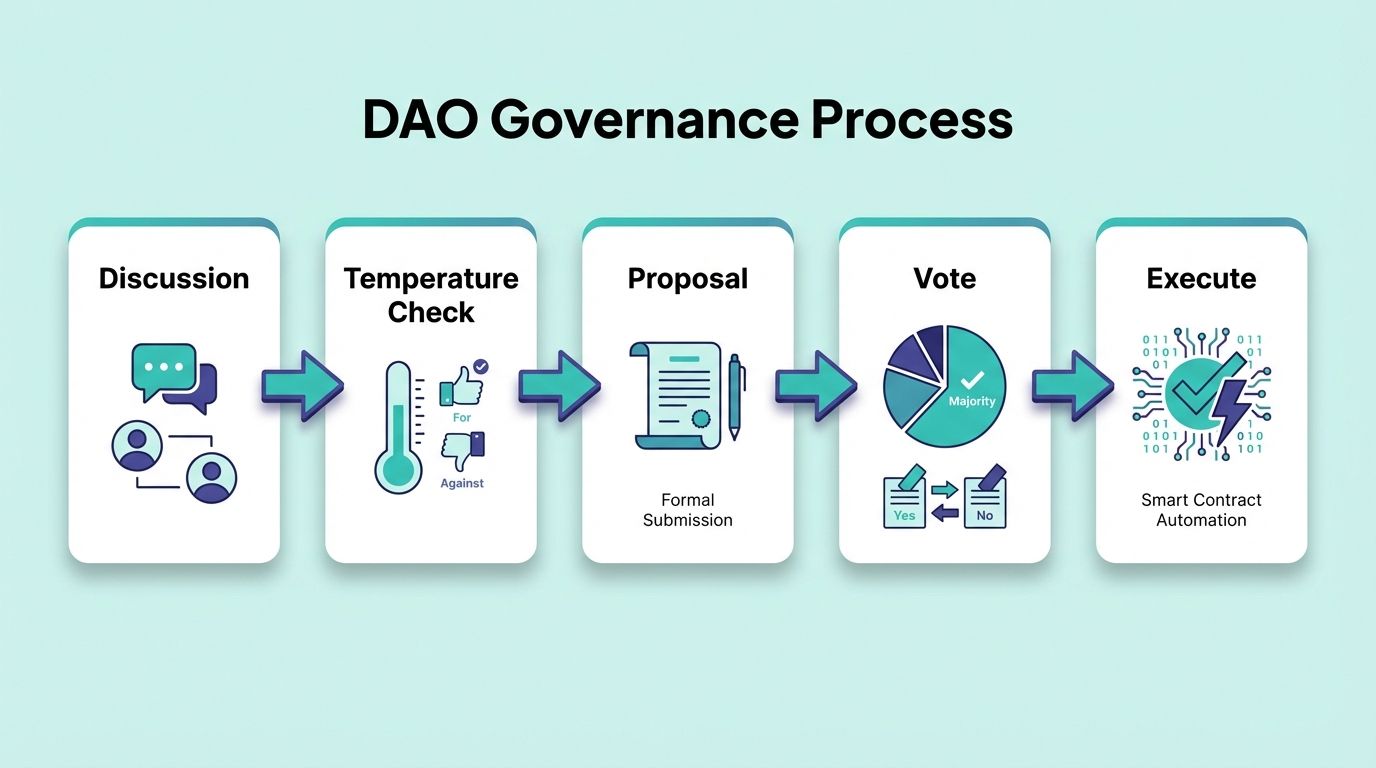
DAO governance follows a structured process that moves from idea to on-chain execution. While the exact steps vary across DAOs, most follow a similar lifecycle involving discussion, formal proposals, and a binding vote.
The Governance Lifecycle
- Discussion phase: A community member identifies an issue or opportunity and posts it to the DAO's forum, such as a Discourse board or a Discord governance channel. Others comment, refine the idea, and gauge interest before a formal proposal is written.
- Temperature check: Many DAOs run a non-binding snapshot poll to measure community sentiment before spending governance resources on a formal vote. This filters out proposals that lack broad support early in the process.
- Formal proposal submission: A proposal is submitted on-chain or through the DAO's governance interface. It typically includes a detailed description, technical specifications, and a clear outcome statement. A minimum token threshold is usually required to submit, which prevents spam.
- Voting period: Token holders cast their votes during a set window, typically three to seven days. Votes are usually weighted by the number of governance tokens held at the time of the snapshot.
- Execution: If the proposal passes quorum and the required approval threshold, it moves to a time-locked execution queue. After the time-lock period expires, the smart contract executes the approved changes automatically.
Token-Weighted Voting
The most common voting model in DAO crypto governance is token-weighted voting, where one token equals one vote. This model is simple and well understood, but it has a known weakness: participants with large token holdings, often called whales, have disproportionate influence over outcomes.
To address this, some DAOs have adopted alternative models. Quadratic voting reduces the influence of large holders by making each additional vote more expensive in token terms. Reputation-based voting ties voting weight to non-transferable contributions rather than purchased tokens. Conviction voting allows token holders to continuously signal support for proposals over time, rewarding sustained commitment rather than last-minute mobilization.
3. Types of DAOs in Crypto
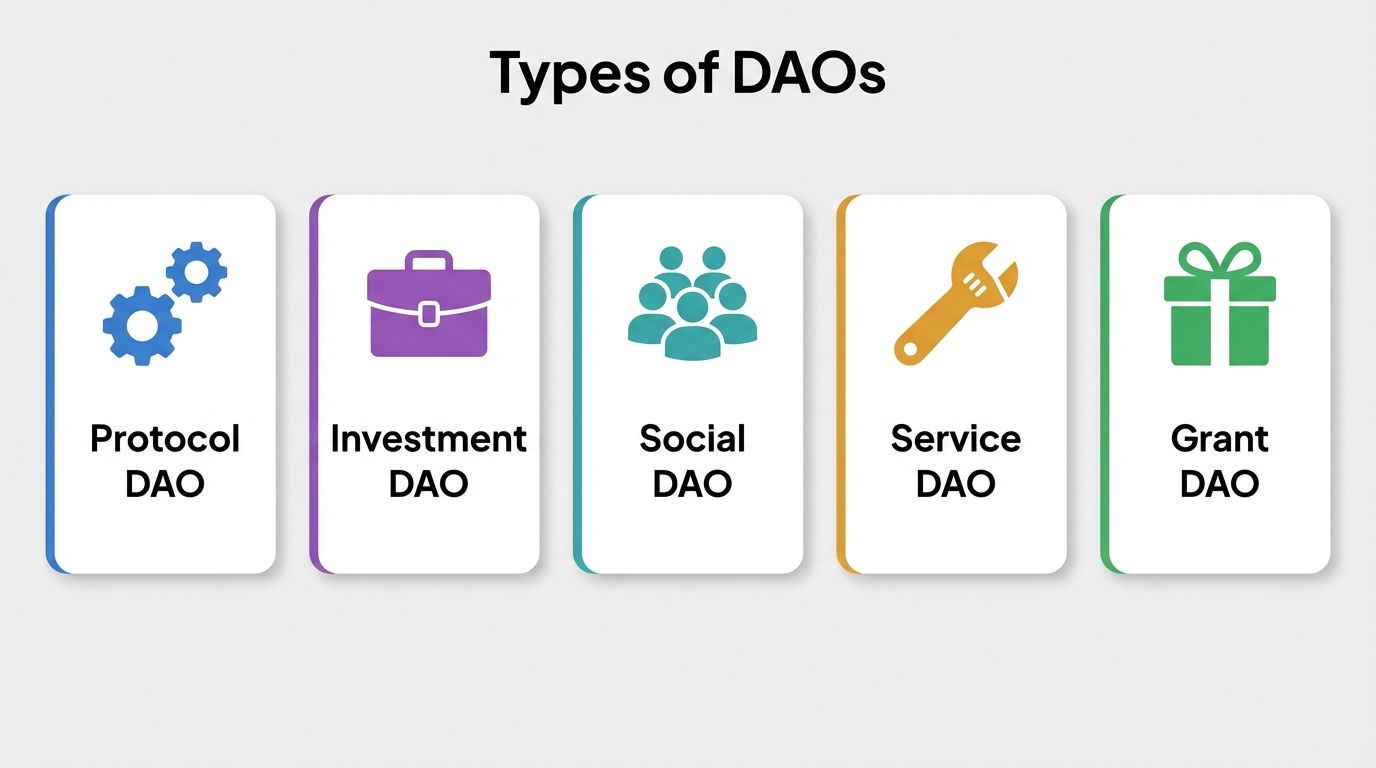
Not all DAOs serve the same purpose. The DAO crypto ecosystem has diversified significantly, and different types of DAOs have emerged to address different coordination problems.
Protocol DAOs
Protocol DAOs govern decentralized finance protocols. MakerDAO, Compound, Aave, and Uniswap are among the most prominent examples. Token holders vote on critical parameters like interest rates, collateral types, fee structures, and smart contract upgrades. These DAOs manage treasuries worth hundreds of millions or even billions of dollars, making their governance decisions high-stakes and heavily watched.
Investment DAOs
Investment DAOs pool capital from members and vote collectively on where to deploy it. The DAO collectively decides on investments in early-stage crypto projects, NFT collections, or real-world assets. Examples include The LAO and MetaCartel Ventures. Members share in the upside proportional to their contribution. Investment DAOs have created a new model for community-run venture capital.
Social DAOs
Social DAOs are membership communities organized around shared interests, identities, or goals. Membership is often gated by holding a specific token or NFT. These DAOs coordinate on content creation, events, networking, and culture. Friends With Benefits (FWB) is a well-known example. Governance in social DAOs often involves decisions about membership criteria, community events, and treasury grants to members working on creative projects.
Service DAOs
Service DAOs function like decentralized talent agencies or consulting collectives. Members contribute their skills, ranging from development and design to legal and marketing, to clients in exchange for compensation. The DAO coordinates work allocation and client relationships, while governance covers operational policies and contributor compensation structures. Raid Guild is a notable example in the Web3 developer space.
Grant DAOs
Grant DAOs allocate funding to projects that benefit their ecosystem. Gitcoin Grants is the most prominent example, using a quadratic funding mechanism to distribute resources based on community matching. These DAOs play a critical role in funding public goods and open-source development that would otherwise struggle to find support through commercial channels.
4. How to Participate in DAO Governance
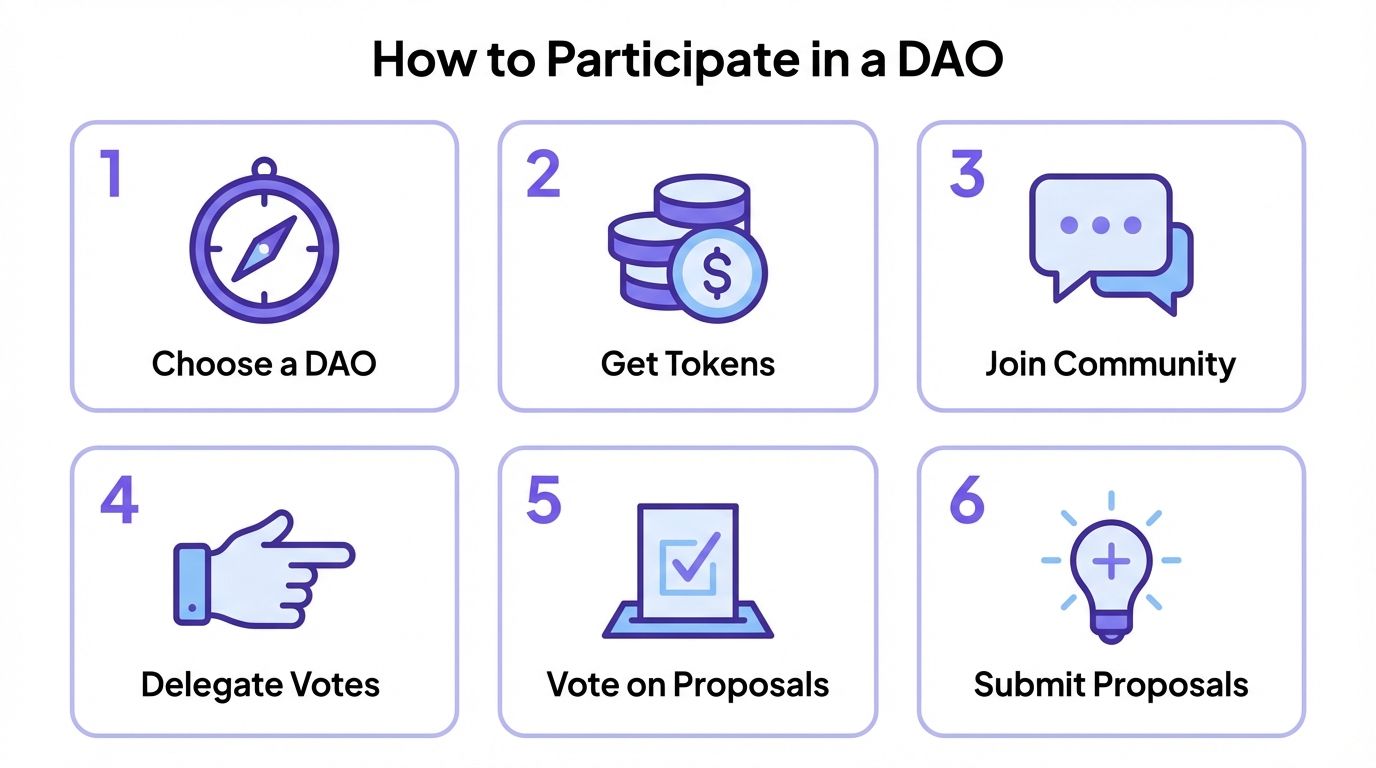
Getting involved in DAO crypto governance is more accessible than most people realize. The main barrier is acquiring governance tokens, but beyond that, participation is open to anyone willing to engage.
Step-by-Step: Getting Started
- Choose a DAO that matches your interests. Start with a protocol you already use or a community that aligns with your values. Participating in governance you understand makes your votes more informed and your contributions more valuable.
- Acquire governance tokens. Most governance tokens can be purchased on decentralized or centralized exchanges. Some are earned through protocol usage, liquidity provision, or contributor grants. Check the DAO's documentation for the preferred acquisition method.
- Join the community channels. Follow the DAO on its governance forum, Discord, and Twitter. Understanding ongoing discussions is essential before submitting or voting on proposals.
- Delegate your votes if you prefer a passive role. Most major DAOs allow token holders to delegate their voting power to trusted community members without transferring ownership of the tokens. This is a good option for holders who lack the time to follow every proposal but still want their voice represented.
- Vote on proposals. Use the DAO's governance interface, such as Snapshot or Tally, to cast your votes. Review the proposal details carefully and refer to community discussions before deciding.
- Submit proposals when you have ideas. If you have experience with the protocol and a well-reasoned improvement, write it up and share it in the discussion forum. Community feedback before a formal submission dramatically improves the likelihood of passage.
5. Risks and Challenges of DAO Governance
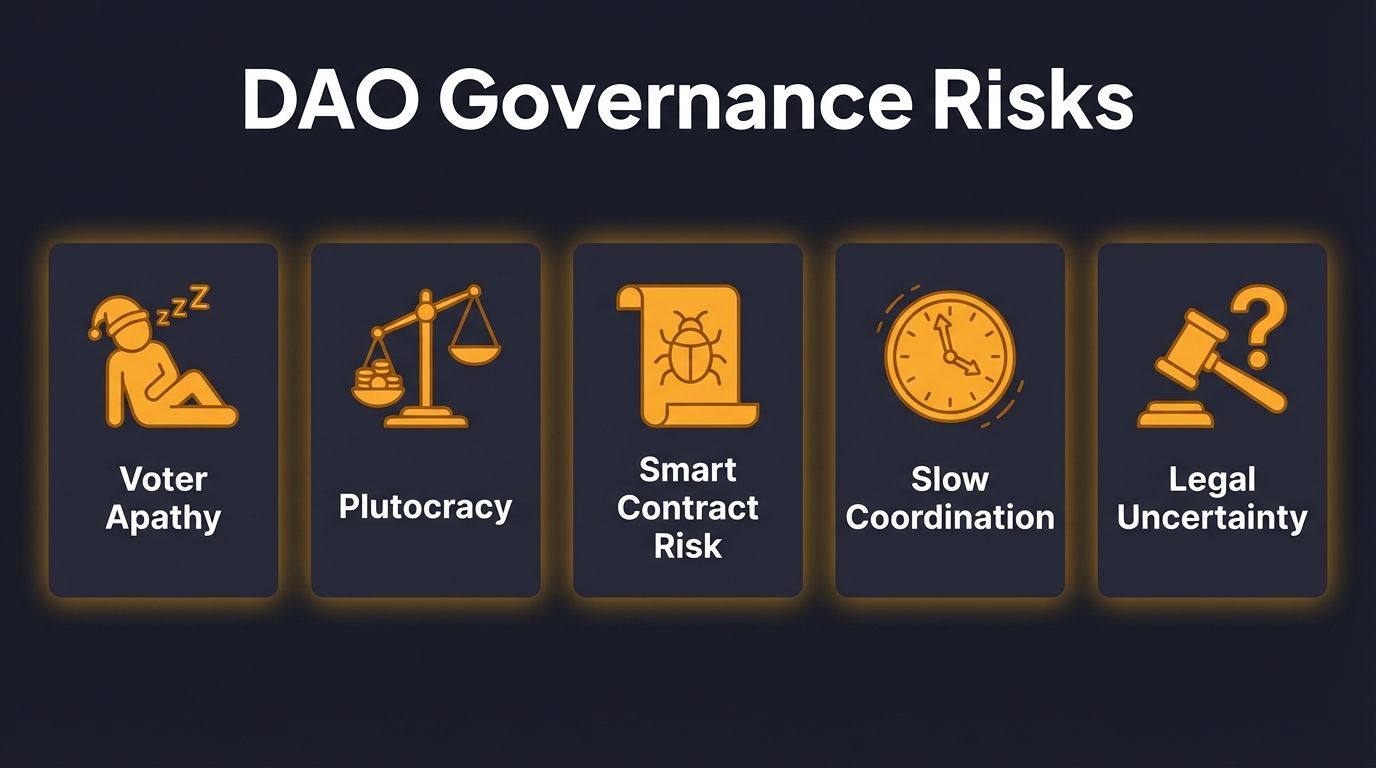
DAO governance is a powerful innovation, but it comes with real limitations that participants and token holders need to understand before committing capital or influence.
Voter Apathy
One of the most persistent problems in DAO crypto governance is low participation. Many token holders never vote. This means that the governance decisions of major protocols are often made by a small percentage of the total token supply. When quorum requirements are not met, proposals fail even if those who do vote are largely in favor. Voter apathy concentrates effective power in the hands of active participants, which can be a handful of large holders or a coordinated bloc.
Plutocracy and Whale Influence
Token-weighted voting creates a plutocratic dynamic by design. Wealthy participants have more governance power than small holders, regardless of the quality of their judgment or their depth of involvement with the protocol. Venture capital firms and early insiders who received large token allocations can effectively veto proposals that threaten their interests. This has been a source of significant controversy in several high-profile governance disputes.
Smart Contract Risk
The governance contracts themselves are software, and software can have bugs. A vulnerability in a governance contract could allow a malicious actor to force through unauthorized proposals or drain the treasury. Several DAOs have suffered governance attacks where an attacker accumulated enough tokens to pass a malicious proposal. The Beanstalk exploit in 2022, for example, involved an attacker using a flash loan to acquire a supermajority of governance tokens, pass a proposal that drained the treasury, and repay the loan, all in a single transaction.
Coordination and Speed
Decentralized governance is slow by nature. A decision that a traditional company could make in a meeting takes days or weeks in a DAO due to discussion periods, voting windows, and time-locks. In fast-moving market conditions, this speed disadvantage can be a significant liability. Some DAOs have introduced emergency multisig mechanisms to handle urgent situations, but these introduce centralization trade-offs.
Legal Uncertainty
The legal status of DAOs varies widely by jurisdiction, and the regulatory landscape is still evolving. In some cases, DAO token holders may be exposed to legal liability as if they were partners in an unincorporated organization. Several DAOs have incorporated legal wrappers, such as Wyoming DAO LLCs or Marshall Islands entities, to provide their members with limited liability protection, but this remains an open and complex area of law.
Take Your Crypto Strategy Further with Altrady
Understanding DAO governance gives you a deeper insight into the protocols you hold tokens in, but governance is just one part of building a successful crypto strategy. Staying on top of market movements, managing your portfolio across multiple exchanges, and executing trades efficiently are just as important.
Altrady is a professional crypto trading platform built for serious participants. It brings your entire crypto portfolio into one unified dashboard, supports advanced order types like trailing stop and scaled orders, and delivers real-time market alerts so you never miss a critical move. Whether you are actively trading governance tokens or managing a long-term DeFi position, Altrady gives you the tools to operate with precision.
Start your free trial today and see how Altrady helps crypto participants trade smarter, manage risk better, and stay ahead of the market every day.
Frequently Asked Questions
What does DAO stand for in crypto?
DAO stands for Decentralized Autonomous Organization. It is an organization governed by smart contracts on a blockchain, where token holders vote on decisions instead of a centralized leadership team. The "autonomous" part refers to the fact that approved governance decisions are executed automatically by the smart contract code, without requiring a human intermediary.
How do you make money from a DAO?
There are several ways to earn returns through DAO participation. Holding governance tokens can generate profit if the value of those tokens increases as the protocol grows. Some DAOs distribute a portion of protocol fees to token holders or stakers. Participation as a contributor in a service DAO can earn direct compensation in tokens. Investment DAOs share returns from collective investments among members proportional to their contribution.
Is voting in a DAO anonymous?
Votes in DAO governance are typically pseudonymous, not anonymous. When you vote using an Ethereum or other blockchain address, the vote is tied to that address on-chain and is permanently visible to anyone. Your real-world identity is not automatically attached, but if your address is linked to your identity through exchange KYC records or public disclosures, your voting history is traceable.
Can a DAO be hacked?
Yes. DAO smart contracts are code, and code can have vulnerabilities. The most famous example is The DAO hack in 2016, where an attacker exploited a reentrancy bug to drain approximately $60 million worth of Ether. More recently, governance attacks have used flash loans to temporarily acquire enough voting power to pass malicious proposals. Audited smart contracts, time-locks, quorum requirements, and emergency multisig controls reduce but do not eliminate these risks.
What is the difference between a DAO token and a regular cryptocurrency?
A DAO governance token specifically grants its holder voting rights within a particular organization or protocol. While it can be traded like any other crypto asset, its primary function is governance participation. A regular cryptocurrency like Bitcoin functions primarily as a medium of exchange or a store of value, with no attached voting rights over a protocol. Some tokens, like those of Uniswap or Aave, serve both purposes: they are tradeable assets and governance tokens simultaneously.