
What Is Layer 2 Crypto?
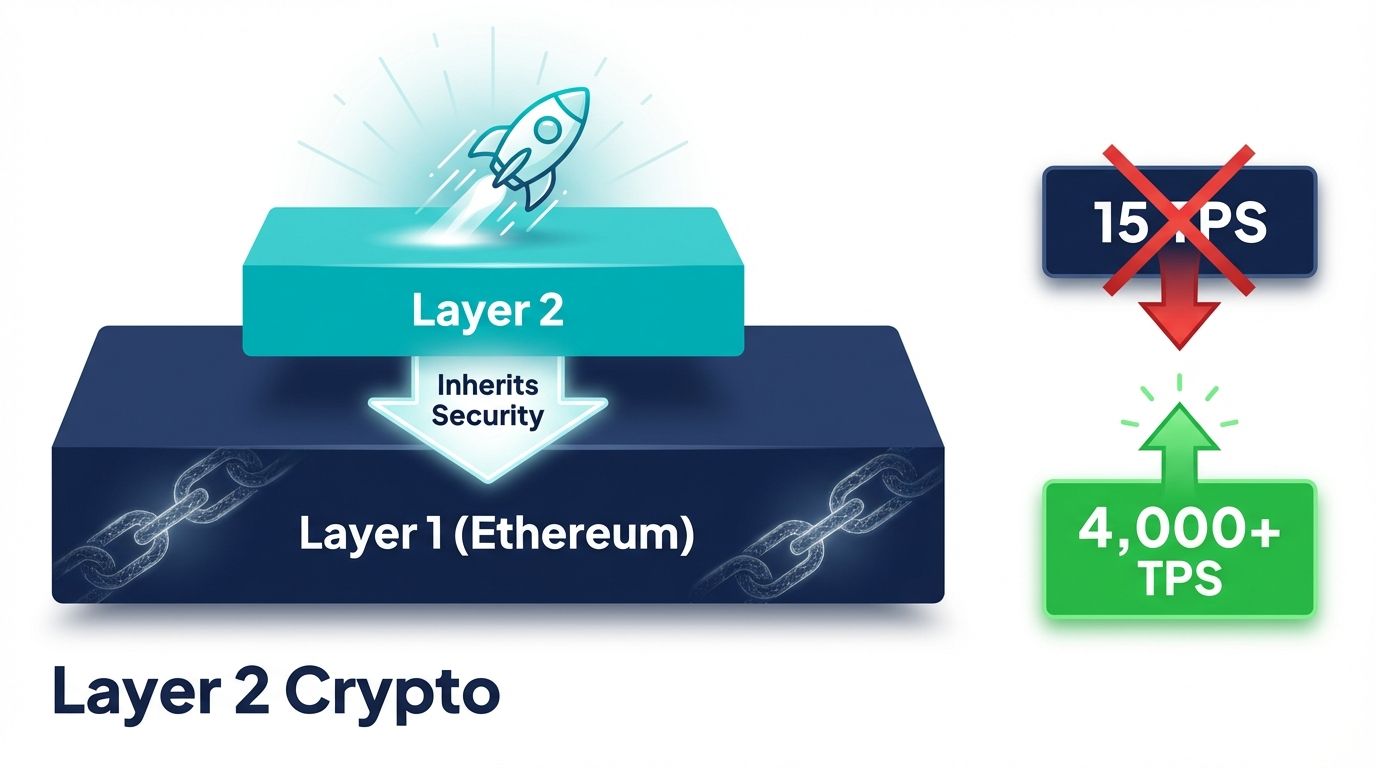
Layer 2 crypto refers to scaling solutions built on top of a base blockchain, most commonly Ethereum. The base chain itself is called Layer 1 (L1). Layer 2 networks process transactions off the main chain, then periodically post compressed proofs or data back to L1 to inherit its security.
The reason L2 solutions exist comes down to two core limitations of Ethereum: high gas fees and low throughput. On congested days, a single Ethereum swap can cost anywhere from $5 to $50 in gas, and the network handles only around 15 transactions per second (TPS). For a global financial system, that ceiling is far too low.
Think of it like a highway. Ethereum is the main highway, well-secured and decentralized, but prone to traffic jams. Layer 2 networks are express lanes running parallel to that highway. They move most of the traffic faster and cheaper, but they still connect back to the main road for final settlement and security. Users get the best of both worlds: the trust guarantees of Ethereum without paying premium prices for every single action.
Since 2022, L2 adoption has grown dramatically. By early 2026, the combined total value locked (TVL) across all Ethereum L2 networks has surpassed $50 billion, reflecting just how central these networks have become to the broader crypto ecosystem.
How Layer 2 Networks Work
Not all L2 solutions use the same technical approach. Three main categories exist, each with different trade-offs in terms of speed, security assumptions, and complexity.
Optimistic Rollups
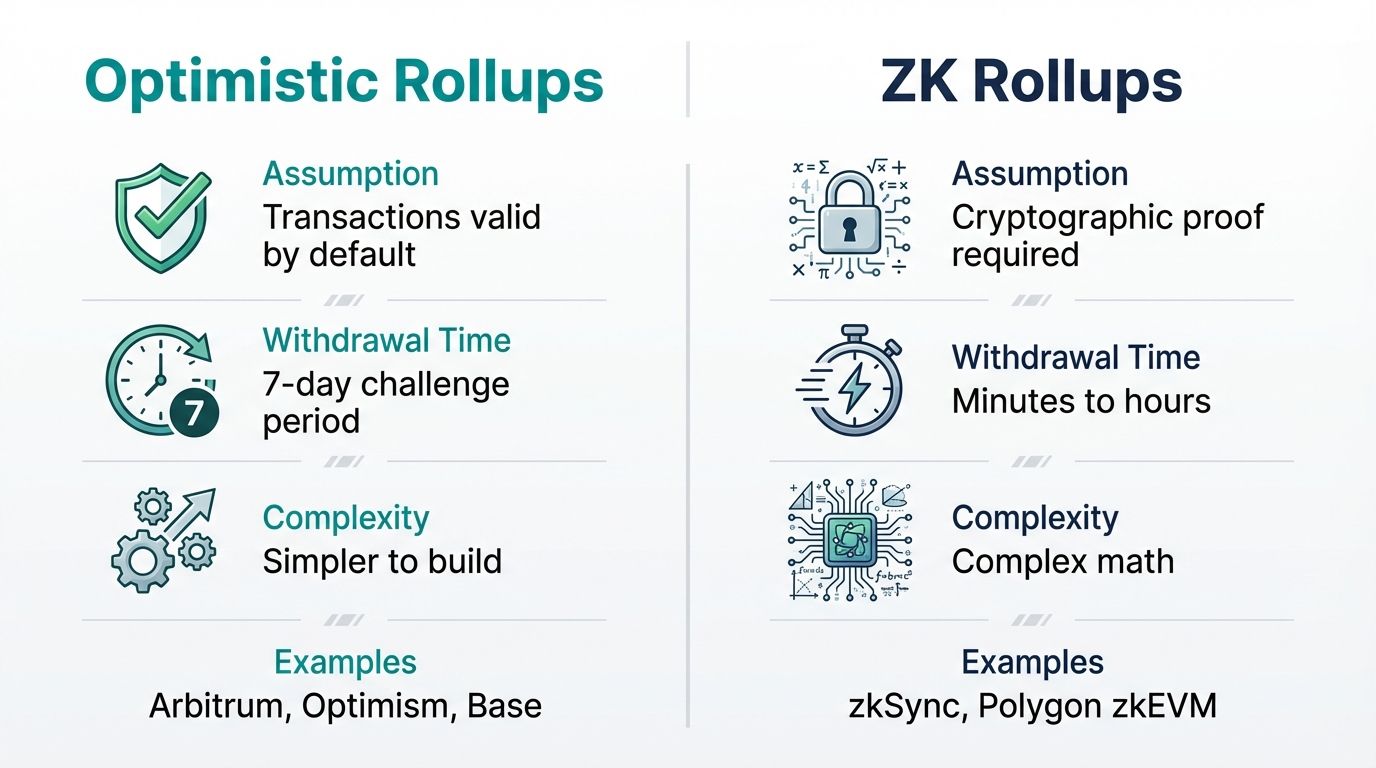
Optimistic rollups bundle hundreds of transactions together, execute them off-chain, and post a compressed summary to Ethereum. The key word is "optimistic": the system assumes all transactions in a batch are valid by default. Anyone who spots a fraudulent transaction can submit a fraud proof during a 7-day challenge window. If the fraud proof is accepted, the bad transaction gets reversed and the malicious actor loses their staked funds.
This 7-day withdrawal delay is the main trade-off. When moving funds from an optimistic rollup back to Ethereum mainnet through the official bridge, users must wait out this window. Third-party liquidity providers can offer instant exits for a small fee, but the native withdrawal always carries the delay. Arbitrum One and Optimism are the two most prominent optimistic rollups in production today.
ZK Rollups (Zero-Knowledge Rollups)
ZK rollups also bundle transactions off-chain, but instead of relying on fraud proofs, they generate a cryptographic proof called a validity proof (or ZK-SNARK/STARK) for every batch. This proof mathematically guarantees that every transaction in the batch was executed correctly. Ethereum verifies the proof on-chain, which is computationally cheap, and the batch gets finalized within minutes rather than days.
The result: ZK rollups have near-instant finality and no challenge window. Withdrawals back to L1 are faster than optimistic rollups. The trade-off has historically been higher development complexity and difficulty supporting the full Ethereum Virtual Machine (EVM). However, networks like zkSync Era and Polygon zkEVM have made significant progress in EVM compatibility, making it much easier to deploy existing Ethereum smart contracts directly on ZK rollups.
Sidechains and Plasma (Brief Overview)
Sidechains are independent blockchains that run alongside Ethereum and connect to it via a two-way bridge. Unlike rollups, they do not post transaction data or proofs back to Ethereum, so their security depends entirely on their own validator set rather than Ethereum's. Polygon PoS, the original Polygon chain, operates as a sidechain. Plasma is an older framework that tried to bundle transactions similarly to rollups but had significant limitations in supporting complex smart contracts. Both approaches are now largely considered legacy compared to modern rollup technology.
Layer 1 vs Layer 2: Key Differences
The differences between L1 and L2 go beyond just speed and cost. Here is a clear breakdown of the main trade-offs:
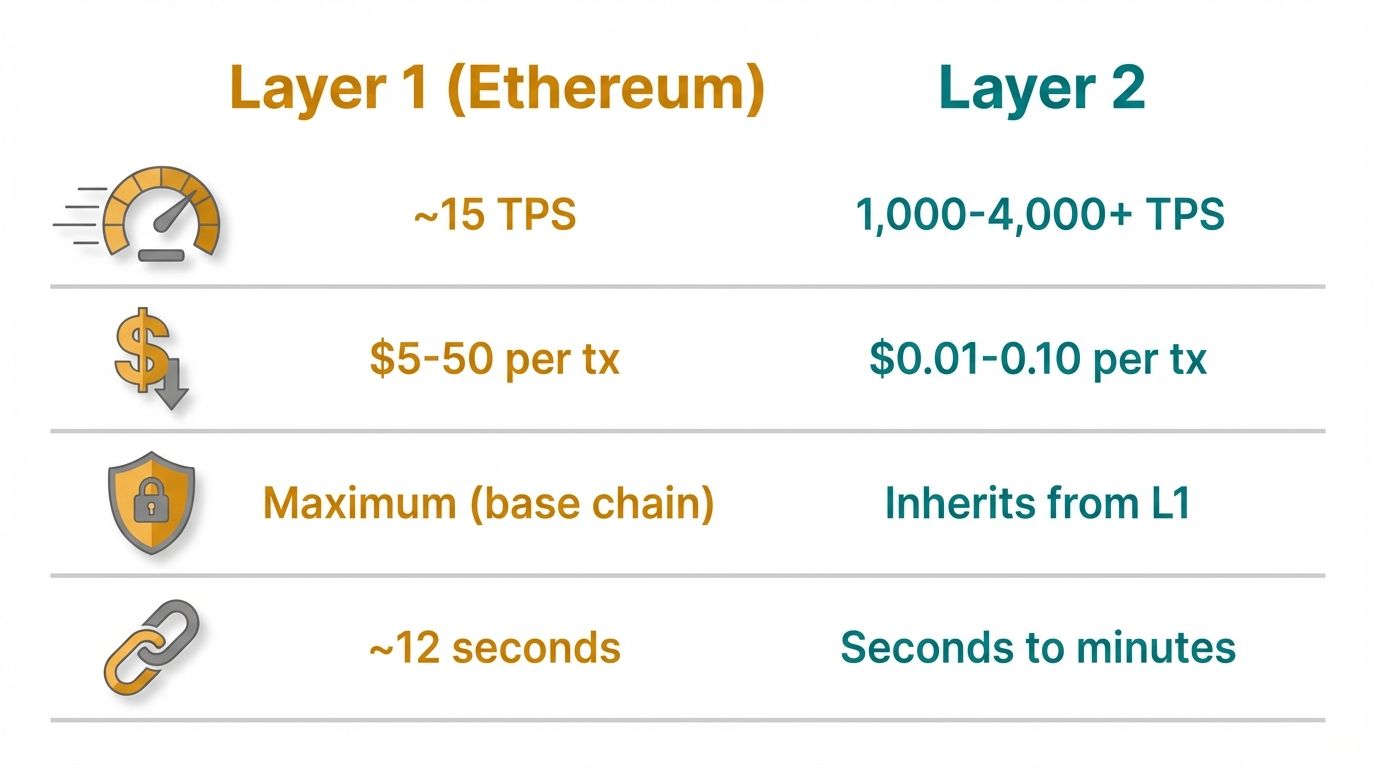
Speed: Ethereum mainnet processes approximately 15 TPS. Leading L2 networks like Arbitrum and Base regularly handle between 1,000 and 4,000+ TPS depending on load, with theoretical capacities even higher for ZK rollups as hardware improves.
Cost: Average transaction fees on Ethereum mainnet range from $5 to $50 during normal to high congestion periods. On L2 networks, the same transaction typically costs between $0.01 and $0.10. After the Ethereum Dencun upgrade in March 2024, which introduced proto-danksharding (EIP-4844), L2 fees dropped further because storing data on Ethereum became significantly cheaper for rollups.
Security: L1 Ethereum benefits from the full weight of Ethereum's validator set and decentralization. Rollup-based L2s inherit Ethereum's security for settlement, but they introduce additional trust assumptions at the sequencer level. Most L2s currently use a centralized sequencer, meaning a single operator orders transactions. Decentralizing sequencers is an active area of development across all major L2 projects.
Decentralization: Ethereum is the most decentralized smart contract platform. L2 networks, while improving, still rely on smaller validator or prover sets and in some cases trusted upgrade keys, representing a meaningful trade-off worth understanding before deploying large capital.
Top Layer 2 Networks in 2026
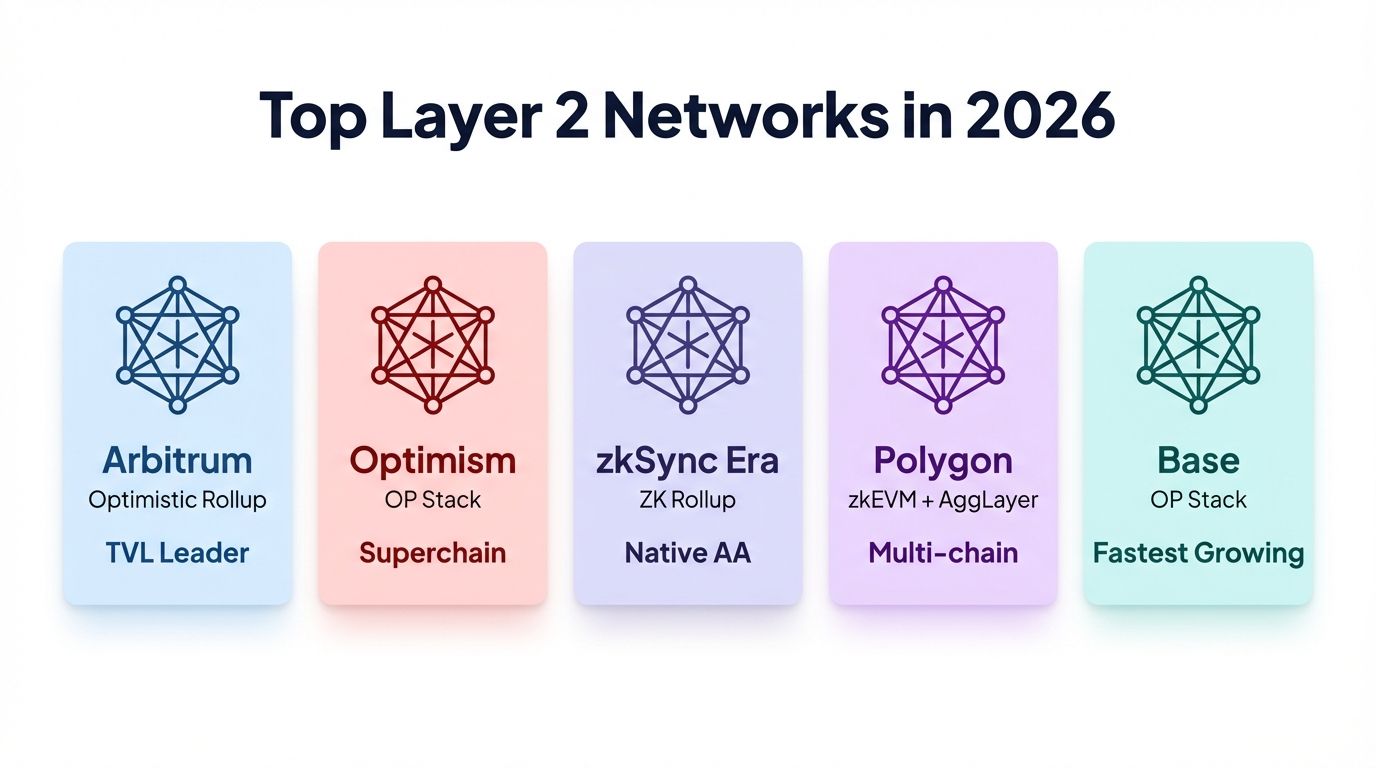
The L2 landscape in early 2026 is dominated by a handful of networks that have proven their reliability, attracted significant developer activity, and accumulated substantial TVL.
Arbitrum
Arbitrum remains the TVL leader among Ethereum L2s, with Arbitrum One holding over $18 billion in TVL as of early 2026. The network operates two chains: Arbitrum One for general-purpose DeFi and smart contracts, and Arbitrum Nova, which is optimized for high-frequency, low-value transactions like gaming and social apps. The Nitro upgrade in 2022 dramatically improved throughput and cut costs further. Arbitrum's governance token, ARB, is used to vote on protocol upgrades through the Arbitrum DAO. The network's strong DeFi ecosystem, including GMX, Pendle, and numerous stablecoin protocols, makes it the default choice for many institutional and retail users.
Optimism / OP Stack
Optimism introduced the OP Stack, a modular open-source framework that lets any team deploy their own L2 built on Optimism's infrastructure. This Superchain vision has proven highly influential. Coinbase's Base, World Foundation's Worldchain, and several other high-profile chains are all built on the OP Stack. Optimism itself holds around $8 billion in TVL, but when you include all OP Stack chains collectively, the ecosystem's footprint is significantly larger. The OP token governs the Optimism Collective, which funds public goods in the Ethereum ecosystem through retroactive funding mechanisms.
zkSync Era
zkSync Era, developed by Matter Labs, is the most deployed ZK rollup by user activity. It launched on mainnet in early 2023 and introduced native account abstraction, meaning every account on zkSync Era can function like a smart contract wallet by default. This enables features like gas fee payment in any token, multi-sig by default, and social recovery without additional setup. zkSync Era's TVL sits around $4 billion in early 2026, with a growing ecosystem of DeFi protocols and gaming applications. The ZK token launched in mid-2024 and is used for staking and governance.
Polygon
Polygon has evolved considerably from its sidechain origins. The flagship product is now Polygon zkEVM, a fully EVM-compatible ZK rollup. Alongside it, Polygon is developing the AggLayer, an interoperability layer designed to unify liquidity across multiple ZK-powered chains into a single aggregated proof submitted to Ethereum. The POL token (formerly MATIC) governs the broader Polygon ecosystem. Polygon's TVL across its zkEVM and legacy PoS chains combined sits around $5 billion, with particular strength in gaming and enterprise use cases. The AggLayer's cross-chain vision positions Polygon as infrastructure for a multi-chain future rather than just a single L2.
Base
Base, launched by Coinbase in August 2023, is the fastest-growing L2 network by transaction count and new user onboarding. Built on the OP Stack, Base has benefited enormously from Coinbase's distribution: users can move funds directly from their Coinbase account to Base with minimal friction. By early 2026, Base processes more daily transactions than any other Ethereum L2 and holds around $10 billion in TVL. A key distinction: Base has no native token. Coinbase has stated it has no plans to issue one, making Base unique among major L2s. The network's developer-friendly tooling and Coinbase's institutional credibility have made it the preferred L2 for consumer crypto applications and social finance projects.
How to Use Layer 2 Networks
Getting started with L2 networks involves three main steps: bridging your funds, configuring your wallet, and understanding withdrawal mechanics.
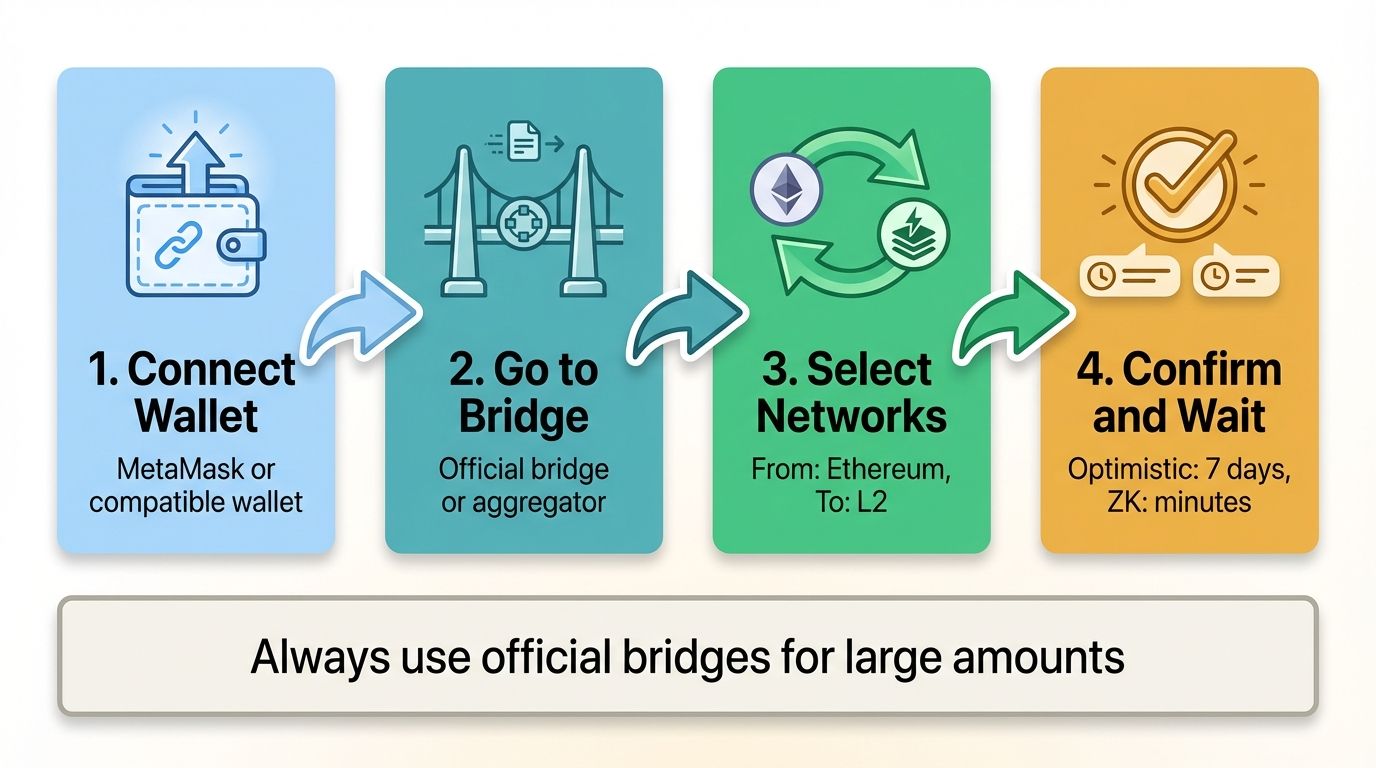
Bridging from L1 to L2: Every major L2 has an official bridge, such as the Arbitrum Bridge, the Optimism Gateway, or the Base Bridge. These are the most secure options because they are maintained by the core teams and settle directly through the L2's smart contracts on Ethereum. For users who want to move funds across multiple L2s without returning to Ethereum mainnet, third-party bridge aggregators like Jumper.exchange (powered by Li.Fi) provide routing across dozens of chains and bridges in a single interface.
Adding a network to MetaMask: Most L2 networks can be added to MetaMask in one click by visiting the network's official website and clicking "Add to MetaMask," or manually through the MetaMask network settings. You will need the chain ID, RPC URL, and currency symbol, all of which are publicly listed on each L2's documentation page. Chainlist.org is a trusted aggregator for verified RPC endpoints.
Withdrawal delays: Moving funds back to Ethereum mainnet carries different timelines depending on the L2 type. ZK rollups like zkSync Era and Polygon zkEVM finalize withdrawals in roughly 15 to 60 minutes after proof generation. Optimistic rollups like Arbitrum One and Optimism have a 7-day challenge window for native withdrawals. If you need faster exits from optimistic rollups, liquidity bridge services can process the withdrawal instantly for a small fee (typically 0.05 to 0.1 percent), with the bridge operator accepting the 7-day wait on their end.
Layer 2 Tokens and How to Trade Them
Several major L2 networks have issued native governance tokens, which have become significant assets in their own right. Understanding what these tokens do, and how to trade them efficiently, is important for any crypto trader with exposure to the L2 sector.
ARB (Arbitrum): ARB governs the Arbitrum DAO and can be used to vote on protocol parameters, treasury allocations, and upgrades to both Arbitrum One and Nova. It is one of the most liquid mid-cap governance tokens in crypto, available on all major centralized and decentralized exchanges.
OP (Optimism): OP governs the Optimism Collective and also plays a role in sequencer economics as the OP Stack's governance expands. As more chains join the Superchain, the scope of OP governance broadens.
POL (Polygon): POL replaced MATIC as the native token of the Polygon ecosystem in late 2024. It serves multiple roles: gas fees on Polygon PoS, staking for validators, and governance across Polygon's growing suite of ZK products.
Base: Base has no native token. Traders seeking exposure to the Base ecosystem often look at projects built on Base rather than a protocol-level asset.
Trading L2 tokens requires keeping track of price action across multiple networks simultaneously. Portfolio trackers that aggregate positions across chains make this significantly easier. Altrady is built precisely for this use case: a professional-grade trading terminal that connects to multiple exchanges and tracks your entire portfolio in one dashboard, with real-time alerts, smart trading tools, and detailed analytics.
If you trade ARB, OP, or POL across different exchanges and want a cleaner, faster workflow, Altrady's multi-exchange dashboard eliminates the need to jump between tabs. You can start with a free trial and explore all of Altrady's features, including grid bots, trailing stops, and portfolio performance reports, before committing to a paid plan. For traders serious about the L2 sector in 2026, having the right tools to monitor fast-moving positions across multiple assets is not optional, it is essential.
Frequently Asked Questions
Is layer 2 crypto safe?
Layer 2 networks built as rollups inherit Ethereum's security for final settlement, making them significantly more trustworthy than independent sidechains. However, most L2s still rely on centralized sequencers and upgradeable smart contracts controlled by a multisig, which introduces trust assumptions. Always check a network's security documentation and consider how much capital you are comfortable holding on any L2 before bridging large amounts.
What is the difference between layer 1 and layer 2?
Layer 1 is the base blockchain (such as Ethereum) that handles final transaction settlement and consensus. Layer 2 is a secondary network that processes transactions faster and cheaper off-chain, then posts proofs or data back to L1 for security. L1 provides the trust foundation; L2 provides the speed and cost efficiency.
Which layer 2 has the lowest fees?
After Ethereum's Dencun upgrade in March 2024, fees on all major rollups dropped substantially. Base and Optimism frequently show average transaction fees below $0.01 for simple transfers. zkSync Era and Arbitrum typically range between $0.01 and $0.05. Fees fluctuate with network congestion, so checking a live gas tracker before transacting is always a good habit.
Do I need a different wallet for layer 2?
No, you do not need a separate wallet. MetaMask and most other EVM-compatible wallets support all major L2 networks. You simply add the L2 network to your existing wallet and bridge funds over. Your same Ethereum address and private key work across all EVM-compatible chains, including Arbitrum, Optimism, Base, zkSync Era, and Polygon.
What is a rollup in crypto?
A rollup is a type of L2 that bundles (rolls up) many transactions into a single batch, executes them off the main chain, and posts a summary back to Ethereum. Optimistic rollups use fraud proofs to verify batches, while ZK rollups use cryptographic validity proofs. Both approaches reduce fees and increase throughput while anchoring security back to Ethereum's base layer.