
NFTs, short for Non-Fungible Tokens, first exploded into mainstream consciousness in 2021 when digital artworks sold for tens of millions of dollars and celebrities rushed to launch their own collections. Then came the crash. Trading volumes collapsed, floor prices plummeted, and the media was quick to declare NFTs dead. But in 2026, the story is more nuanced and far more interesting than either the hype or the obituaries suggested.
Today, NFTs are embedded in gaming economies, real-world asset ownership, music royalties, and event ticketing. The speculative frenzy has faded, and what remains is a technology with genuine, measurable utility. For crypto traders and investors who want to understand where capital is flowing, understanding NFTs is no longer optional. This guide breaks down how NFTs work, what types exist, how to trade them, and how to evaluate whether a specific NFT is worth your money.
1. How NFTs Work: Blockchain, Standards, and Ownership
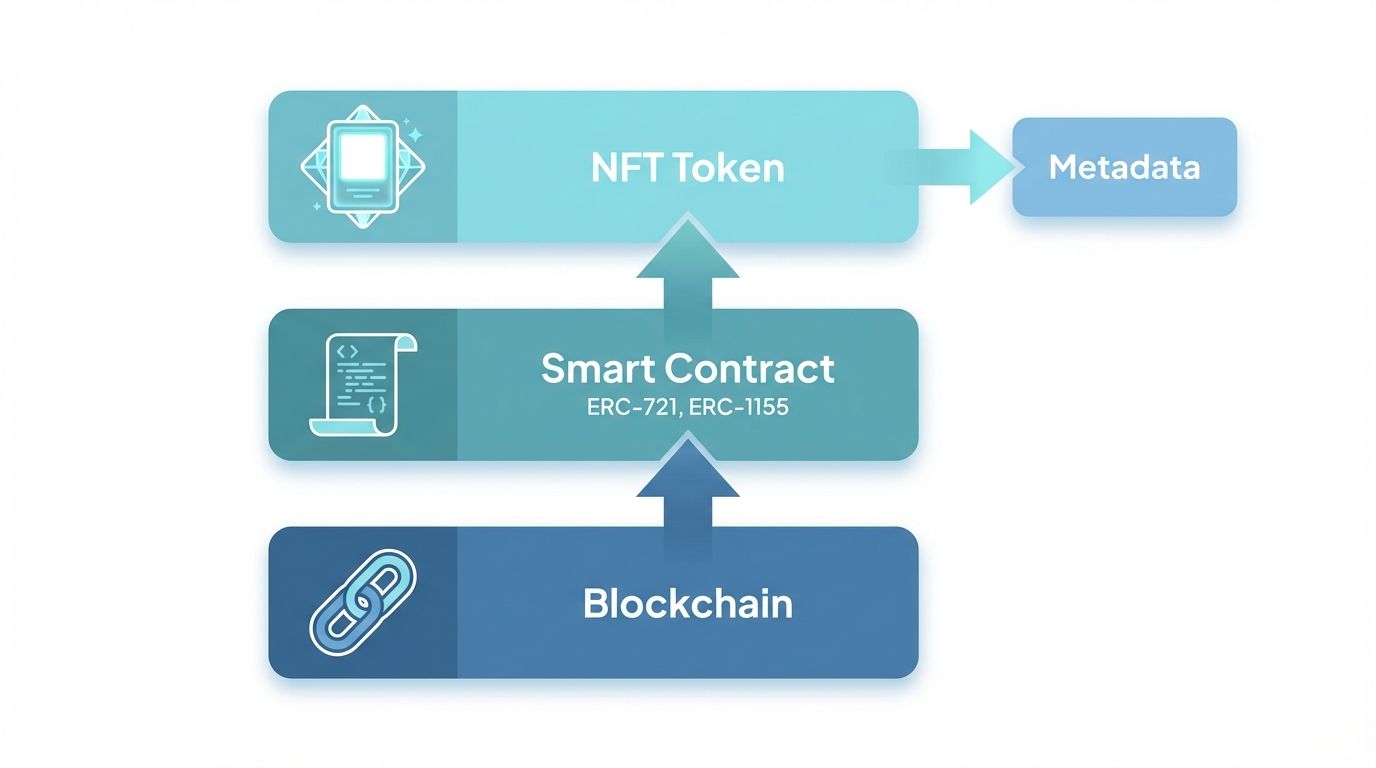
An NFT is a unique cryptographic token stored on a blockchain. Unlike Bitcoin or Ether, which are fungible (every unit is interchangeable with another of the same value), each NFT has a distinct identifier that makes it one-of-a-kind, or part of a limited, numbered series.
The mechanics behind NFTs rely on a few core concepts:
- Token standards. Most NFTs are built on Ethereum using either the ERC-721 standard, which creates fully unique tokens, or the ERC-1155 standard, which allows a single contract to manage both fungible and non-fungible tokens in one deployment. ERC-1155 is particularly common in gaming, where a player might hold 500 copies of a common sword and one unique legendary item under the same contract.
- Metadata. The token itself is just a pointer. The actual content (the image, video, or document) is referenced through metadata, typically stored either on-chain or via decentralized storage protocols. Where metadata lives matters a great deal for longevity. If a project stores images on a centralized server that shuts down, the NFT becomes an empty pointer.
- Ownership and transferability. Ownership is recorded on the blockchain as a wallet address linked to a token ID. Transfers are logged as transactions, creating an immutable provenance trail. This is why NFTs are useful for proving original ownership, not just of digital art, but of any asset that benefits from a transparent, tamper-proof record.
- Smart contract royalties. Creators can embed royalty logic directly into the contract, so they automatically receive a percentage every time the NFT is resold on a compatible marketplace. In practice, royalty enforcement has become a contested issue, with some marketplaces making them optional to compete on fees.
The underlying blockchain matters too. While Ethereum remains dominant, NFTs are minted and traded on Solana, Polygon, Flow, Immutable X, and several other networks, each with different fee structures, speeds, and community ecosystems.
2. Types of NFTs: Far Beyond Digital Art
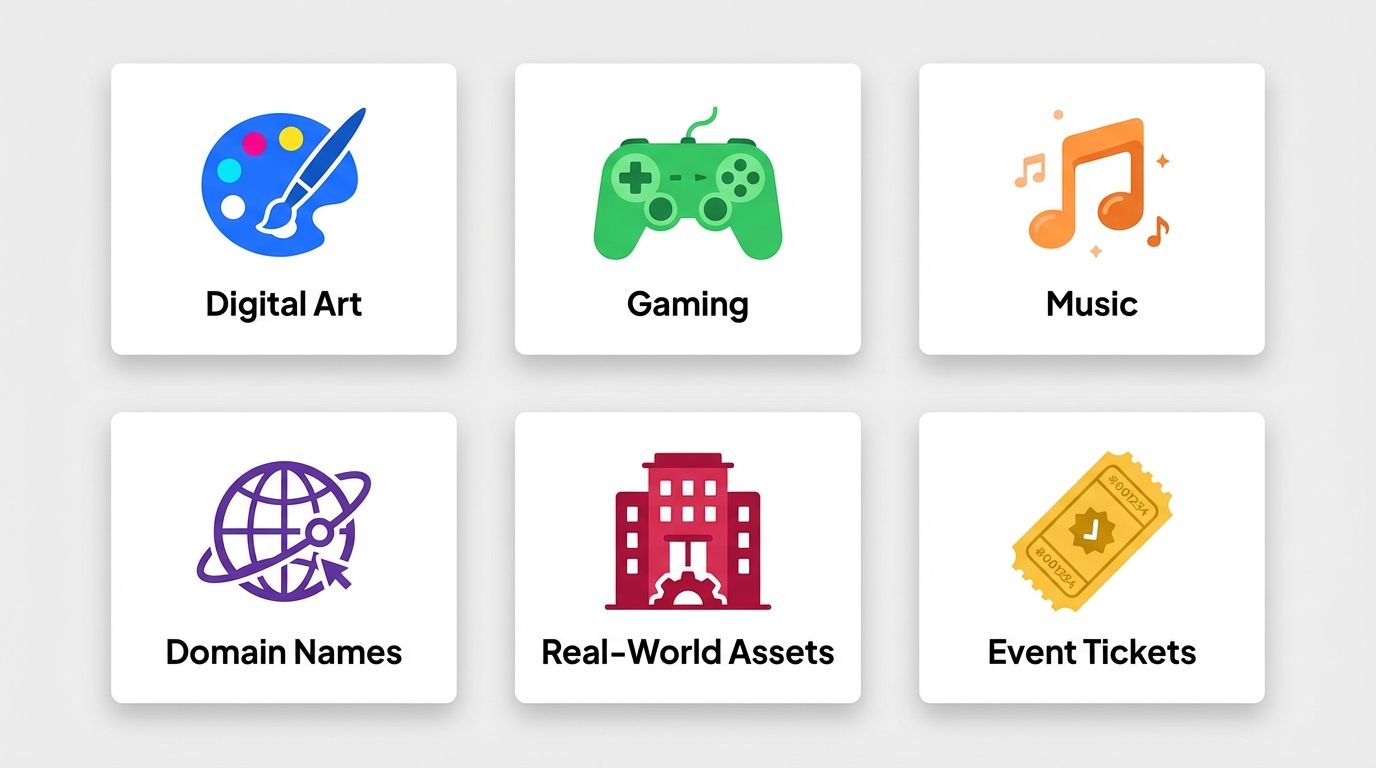
The popular image of NFTs as overpriced JPEGs misses the full spectrum of what the technology enables. In 2026, NFTs span a wide range of categories, each with its own market dynamics.
-
Digital Art and Collectibles
This remains the most culturally visible category. Generative art collections, 1-of-1 fine art pieces, and profile picture (PFP) collections all fall here. The market has matured considerably, with a sharper divide between high-value blue-chip collections and lower-tier collections that struggle to maintain liquidity.
-
Gaming Items and Virtual Real Estate
Blockchain games use NFTs to represent in-game assets: weapons, characters, land parcels, and skins. Players can genuinely own these items, trade them outside the game, and take them to secondary markets. The play-to-earn model has gone through significant corrections, but asset ownership within gaming remains one of the most durable NFT use cases.
-
Music and Entertainment Rights
Artists use NFTs to sell limited edition releases, grant holders access to exclusive content, or even distribute fractional royalty rights. Some platforms allow fans to invest in a song, earning a share of streaming revenue tied to an NFT they hold. This model cuts out intermediaries and creates a direct financial relationship between creator and audience.
-
Domain Names
Blockchain-based naming services issue domain names as NFTs. Owning one of these gives you a human-readable address that maps to a wallet address, simplifying crypto transactions. Unlike traditional domain registrations, these NFT domains are stored in your wallet and have no annual renewal fees.
-
Real-World Asset Tokenization
One of the fastest-growing NFT categories in 2026 involves tokenizing ownership of physical assets: real estate, luxury goods, commodities, and even intellectual property. An NFT can represent a fractional share of a property, allowing investors to buy a piece of real estate with far less capital than a traditional purchase would require. Regulatory frameworks around this category are evolving rapidly.
-
Event Tickets and Access Passes
NFT tickets solve longstanding problems in event ticketing, including scalping, counterfeiting, and lack of artist royalties on resales. When a ticket is an NFT, the original issuer can program royalties into every secondary sale, the ticket's full transaction history is visible on-chain, and authenticity can be verified instantly.
3. How to Buy and Sell NFTs: A Practical Walkthrough
Getting started with NFT trading requires a compatible crypto wallet, funds in the right cryptocurrency, and access to a marketplace. Here is how the process typically works.
- Set up a wallet. For Ethereum-based NFTs, MetaMask is the most widely supported option. For Solana NFTs, Phantom is standard. These are non-custodial wallets, meaning you control your private keys. Write down your seed phrase and store it securely offline. Losing your seed phrase means losing access to everything in the wallet permanently.
- Fund your wallet. Purchase ETH or SOL on a centralized exchange, then transfer it to your wallet. For Ethereum NFTs, you will need ETH not just for the purchase price but also for gas fees, which are the network transaction costs. Gas fees fluctuate significantly based on network congestion.
- Choose a marketplace. OpenSea and Blur are the dominant Ethereum NFT marketplaces. Magic Eden has expanded from Solana to become a multi-chain platform. Each marketplace has different fee structures, interface tools, and community norms. Blur, for example, is heavily oriented toward professional traders and offers advanced analytics and bulk trading features.
- Buying an NFT. You can either purchase an NFT listed at a fixed price or place a collection offer (a bid for any NFT from a specific collection). Confirm the transaction in your wallet, pay the gas fee, and the NFT transfers to your address once the transaction is confirmed on-chain.
- Listing an NFT for sale. Connect your wallet to a marketplace, navigate to the NFT in your profile, and select list. You choose a price and duration. The marketplace will ask you to sign a transaction (sometimes for a small fee) to authorize the listing. When a buyer accepts, the sale executes automatically via smart contract.
- Understanding gas fees. On Ethereum mainnet, gas fees can range from a few dollars during low-congestion periods to well over a hundred dollars during peak demand. For frequent or small-value trades, Layer 2 networks like Polygon or Immutable X dramatically reduce costs. Many traders time their transactions for off-peak hours to minimize fees.
4. How to Evaluate an NFT Before Buying
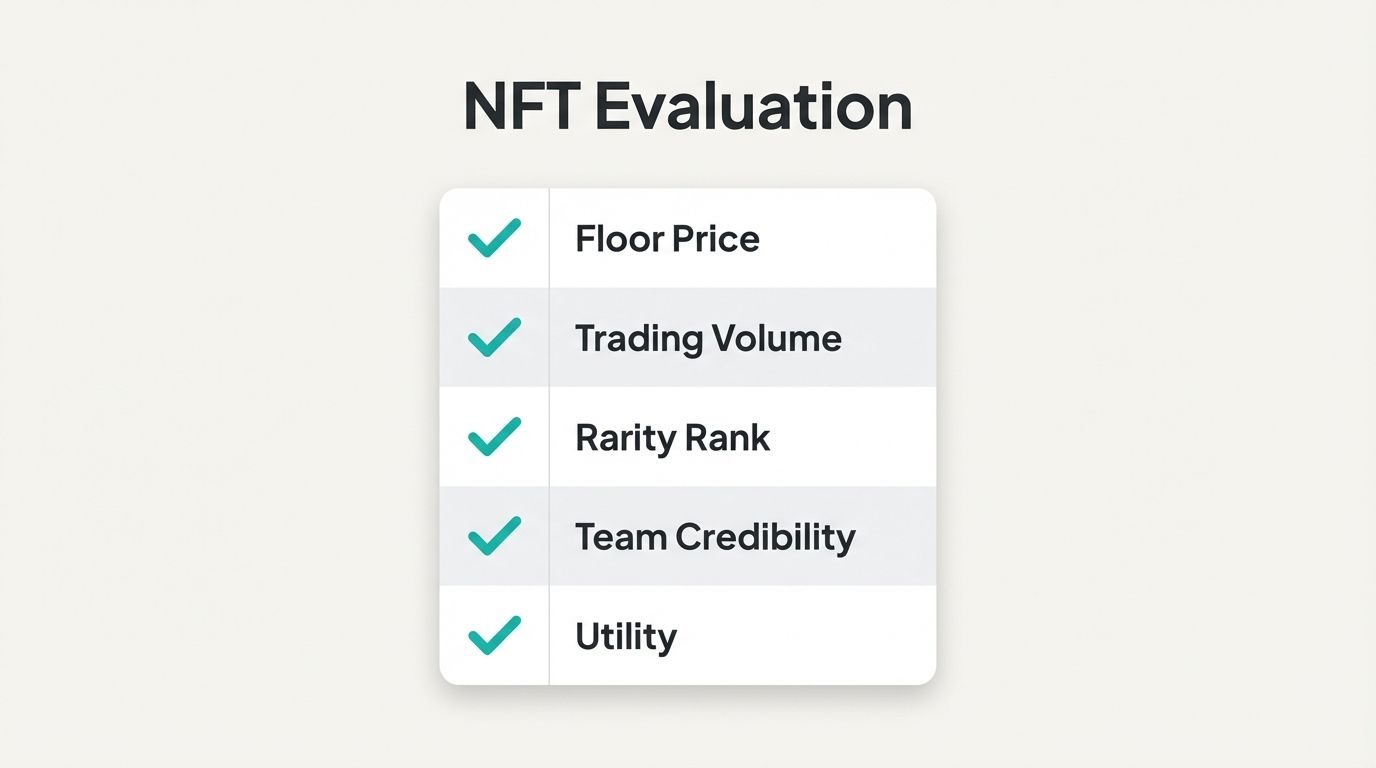
Most losses in NFT investing come from buying without proper due diligence. The following factors help separate potentially valuable NFTs from those likely to decline.
-
Floor Price and Trading Volume
The floor price is the lowest listed price in a collection, and it is the most commonly cited metric for collection health. But floor price alone is misleading. Always check daily and weekly trading volume alongside it. A collection with a high floor price and near-zero volume is illiquid, meaning you may not be able to sell when you want to. High volume with a rising floor signals genuine demand.
-
Rarity and Trait Distribution
In most generative collections, individual NFTs are assigned traits at random during mint. Some trait combinations are far rarer than others, and rare traits typically command price premiums. Rarity ranking tools allow you to check where a specific token ranks within its collection. An NFT ranked in the top 1% of its collection for rarity often trades at a significant premium to the floor, assuming demand for the collection exists.
-
Collection Size and Supply Dynamics
Smaller collections are not automatically more valuable, but supply affects scarcity. A collection of 10,000 items distributed across thousands of holders has different liquidity characteristics than a 500-item collection. Check how concentrated ownership is. If 10 wallets hold 40% of the supply, a coordinated dump could severely damage the floor price.
-
Team Credibility and Roadmap Delivery
Anonymous teams are common in crypto, but accountability matters. Research whether the team has previously built and delivered on past projects. Review their roadmap and check whether prior milestones were actually met. A pattern of missed deliveries is a red flag regardless of how impressive the current promises sound.
-
Utility and Community Strength
Ask what the NFT does beyond existing as a token. Does it grant access to a private community, unlock in-game functionality, provide revenue sharing, or offer real-world perks? NFTs with genuine, ongoing utility tend to maintain demand better than those whose value rests entirely on speculation. Community size and engagement on platforms like Discord and X (formerly Twitter) are reasonable proxies for the health of an ecosystem.
-
Smart Contract Audit Status
For projects involving staking, breeding mechanics, or complex token interactions, verify whether the underlying smart contracts have been audited by a reputable third party. Unaudited contracts carry exploit risk, and a single vulnerability can drain value from an entire ecosystem overnight.
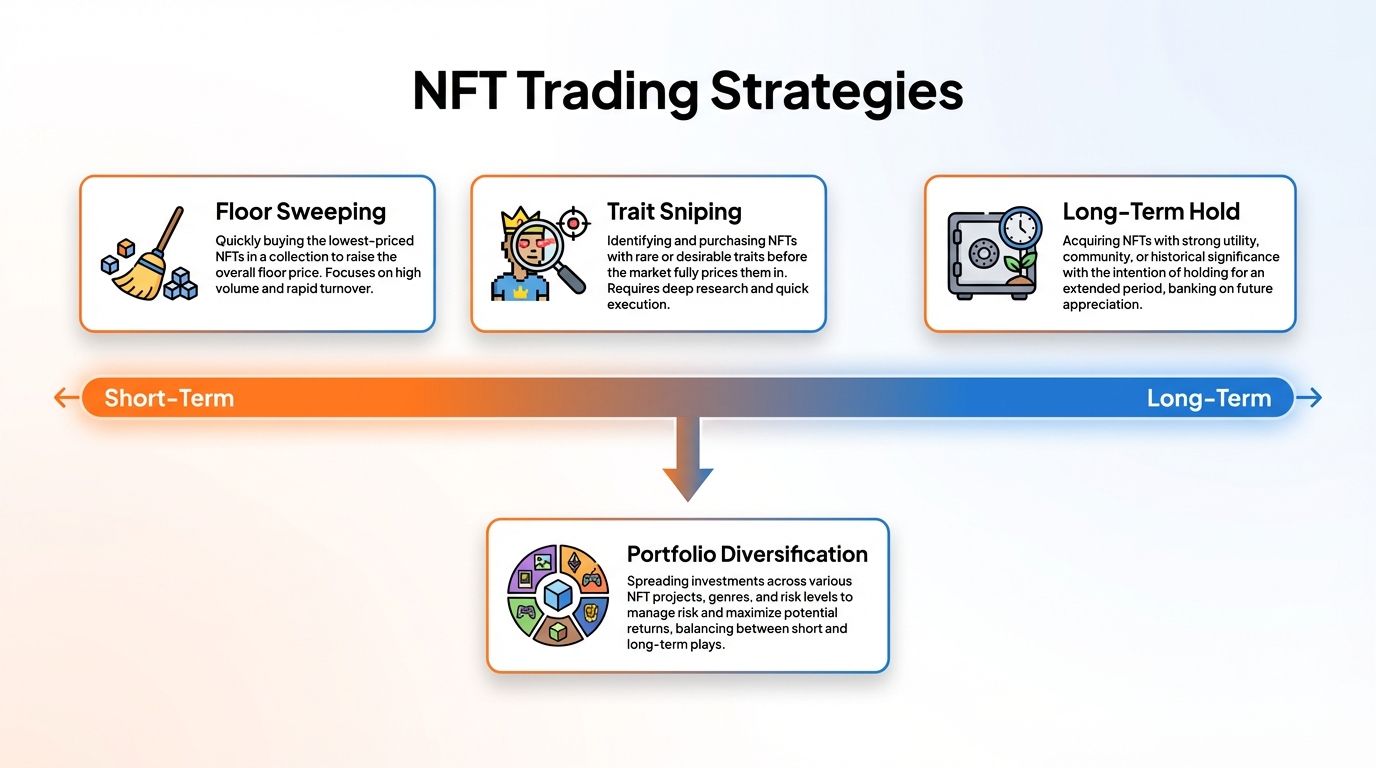
5. NFT Trading Strategies: From Flipping to Long-Term Holds
Professional NFT traders employ a range of strategies depending on their risk tolerance, capital size, and time commitment. Here are the most common approaches used in 2026.
-
Floor Sweeping
Floor sweeping involves buying a large number of floor-priced NFTs from a collection in rapid succession, typically to signal bullish conviction, increase the floor, or corner supply ahead of an anticipated price move. It requires significant capital and carries high concentration risk. Platforms like Blur make bulk purchases easier with aggregated listings and reduced fees for high-volume traders.
-
Trait Sniping
Trait sniping means hunting for underpriced rare NFTs, particularly those recently listed by sellers who may not realize the rarity value of specific trait combinations. Traders use rarity tools and price scanners that alert them when a statistically rare NFT is listed below market value. Speed matters here, as desirable snipes are often contested by bots.
-
Short-Term Flipping
Flipping involves buying NFTs at or near floor price and selling them quickly for a small profit margin. The strategy depends on high volume and tight spreads. It works best in liquid collections with consistent trading activity. The main risks are gas fees eating into thin margins, sudden floor drops, and failed transactions that still incur gas costs.
-
Long-Term Holds (Diamond Handing)
Some investors identify early-stage projects with strong fundamentals, buy during the mint or shortly after, and hold for months or years. This approach requires conviction in the team and the long-term utility case. The potential upside is larger than short-term flipping, but so is the downside if the project fails to deliver.
-
NFT Portfolio Diversification
Experienced traders spread exposure across multiple collections, categories, and blockchains rather than concentrating in one project. A diversified NFT portfolio might include a blue-chip collectible for stability, a gaming asset with active utility, and a speculative position in an emerging collection. This mirrors the logic of conventional portfolio management applied to a higher-volatility asset class.
-
Tracking NFT-Related Token Exposure
Many NFT ecosystems have associated governance or utility tokens. Investing in the token of a growing NFT marketplace or blockchain gaming platform gives indirect exposure to NFT market growth without directly holding illiquid JPEGs. Monitoring the performance of these tokens alongside NFT market metrics can provide useful signals for both entry and exit timing.
Take Your NFT Strategy Further with Altrady
Understanding NFTs is only part of the equation. Whether you are tracking NFT-related tokens, managing a multi-chain crypto portfolio, or looking for better tools to monitor market signals, having the right trading platform makes a measurable difference.
Altrady is a professional crypto trading and portfolio management platform designed for serious traders. It offers real-time portfolio tracking across multiple exchanges and wallets, advanced charting, automated trading bots, and signal alerts that help you stay ahead of market moves. As NFT ecosystems drive demand for associated tokens and layer-1 assets, having a consolidated view of your entire crypto exposure becomes even more important.
Start your free trial of Altrady today and see how a professional-grade platform can sharpen your trading decisions across every corner of the crypto market, including the growing NFT ecosystem.
Frequently Asked Questions About NFTs
What is the difference between an NFT and a regular cryptocurrency?
A regular cryptocurrency like Bitcoin or Ether is fungible, meaning each unit is identical and interchangeable with any other unit of the same denomination. An NFT, by contrast, is non-fungible. Each token has a unique identifier that distinguishes it from every other token, even within the same collection. This uniqueness is what allows NFTs to represent ownership of specific items, artworks, or assets rather than generic monetary value.
Are NFTs still worth investing in during 2026?
The answer depends heavily on which NFTs and what investment thesis you are applying. The speculative bubble of 2021 to 2022 has fully deflated, and many collections from that era have little to no market value. However, the technology has matured, and NFTs tied to real utility (gaming assets, tokenized real-world assets, royalty-bearing music tokens, event access) continue to attract genuine demand. Investing in NFTs in 2026 requires the same due diligence as any other asset class.
How do gas fees affect NFT trading profitability?
Gas fees are a real cost that can significantly erode margins, especially for lower-value trades on Ethereum mainnet. Strategies to manage this include trading on lower-fee networks (Polygon, Solana, Layer 2 Ethereum rollups), timing transactions during periods of low network congestion, and focusing on higher-value trades where the fee is a smaller percentage of the transaction. Always factor gas costs into your entry and exit math before committing to a trade.
What is a floor price and why does it matter?
The floor price is the lowest asking price among all currently listed NFTs in a collection. It represents the minimum amount needed to enter a collection immediately and serves as the most widely used benchmark for collection value. A rising floor alongside rising volume suggests healthy demand. A falling floor with low volume suggests sellers are capitulating and buyers are absent, which is typically a bearish signal.
Can I lose all my money investing in NFTs?
Yes. NFTs are speculative assets with no guaranteed underlying value. A collection can go to zero if the team abandons the project, the utility fails to materialize, or broader market sentiment turns negative. Never invest more than you can afford to lose completely, diversify across multiple projects rather than concentrating in one, and always do independent research rather than relying on social media promotion.
What wallets are best for storing NFTs?
For Ethereum-based NFTs, MetaMask is the most widely compatible option. Coinbase Wallet is another reliable choice with a cleaner interface for beginners. For Solana NFTs, Phantom Wallet is the standard. For maximum security, especially for high-value holdings, hardware wallets like Ledger allow you to store private keys offline while still connecting to NFT marketplaces when needed.
2026 Update: What to Check Before You Act
NFTs are easier to understand when separated into ownership, utility, liquidity, and marketplace risk. A strong story does not guarantee a liquid exit.
| Check | What to review | Why it matters |
|---|---|---|
| Collection quality | Review creator history, holder distribution, roadmap delivery, and real utility. | Separates durable collections from short-lived hype. |
| Liquidity | Check floor depth, sales frequency, bid support, and marketplace concentration. | NFTs can be hard to exit even when the displayed floor price looks strong. |
| Wallet safety | Verify marketplace URLs, collection contracts, and approval permissions. | NFT scams often target signatures and approvals rather than passwords. |
Quick trader checklist
- Do not buy solely because the floor price is rising.
- Check recent sales, not only listed prices.
- Use a dedicated wallet for minting or interacting with unfamiliar NFT sites.
FAQ
What makes an NFT risky to trade?
NFTs are risky because liquidity can disappear quickly, floor prices can be manipulated, and malicious links can target wallet approvals. Traders should verify contracts and recent sales before buying.