
Yield farming has become one of the most discussed strategies in decentralized finance. Since its explosive rise during the DeFi Summer of 2020, it has evolved from a niche experiment into a structured way for crypto holders to put their assets to work. Instead of letting tokens sit idle in a wallet, yield farming lets you deploy them into protocols that generate returns, sometimes far exceeding what traditional finance can offer.
The concept is straightforward in principle: you supply liquidity or assets to a DeFi protocol, and in return, you earn rewards. The complexity, and the risk, lies in how those rewards are structured, where the yield actually comes from, and how to protect yourself from the traps that have burned many participants.
This guide covers everything an intermediate crypto user needs to know about yield farming in 2026, from the mechanics to the risks and a step-by-step path to getting started.
1. How Yield Farming Works
At its core, yield farming is about supplying capital to a DeFi protocol in exchange for a financial return. Understanding the mechanics is essential before putting any funds at risk.
Liquidity Pools
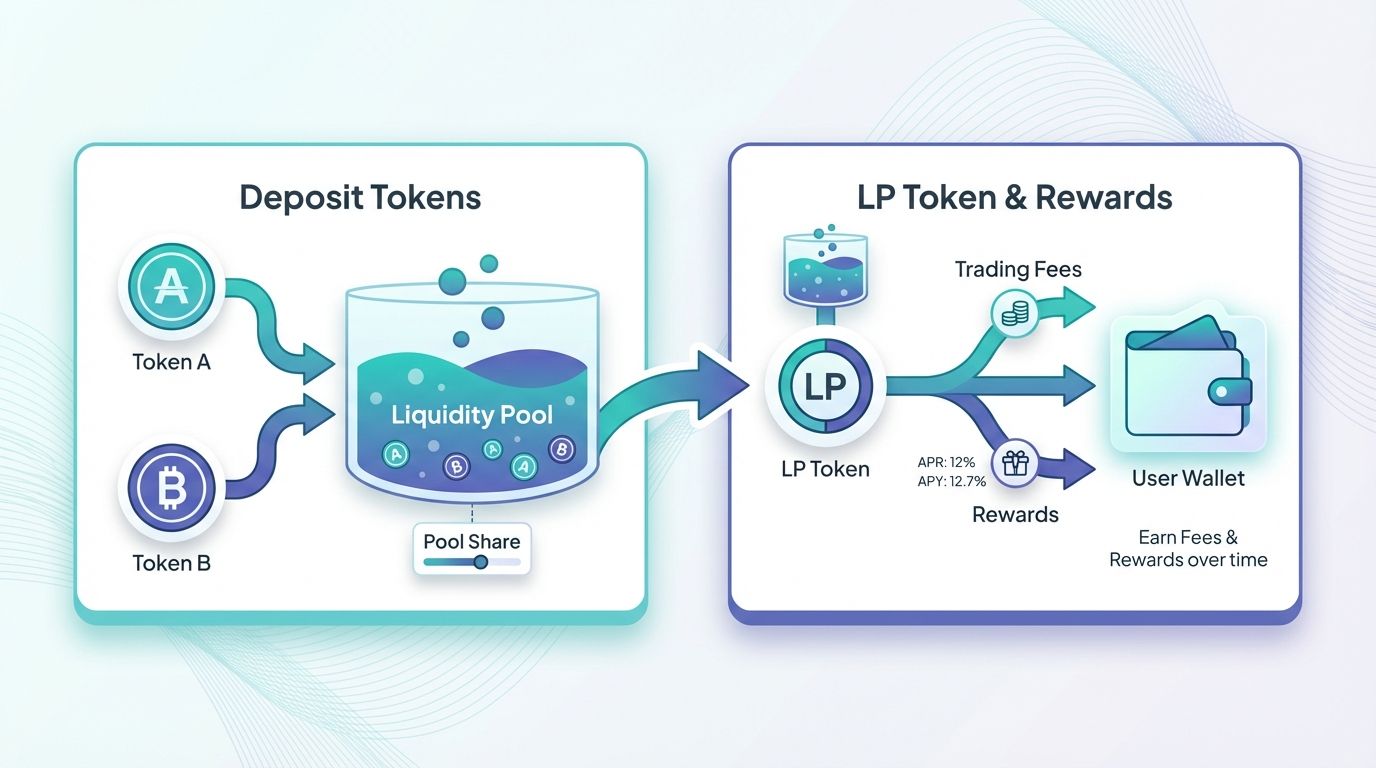
Most yield farming activity happens inside liquidity pools. A liquidity pool is a smart contract that holds pairs of tokens, such as ETH and USDC, and allows users to trade between them without a traditional order book. When you deposit tokens into a pool, you become a liquidity provider (LP).
The protocol uses your deposited tokens to facilitate swaps. In exchange, a portion of every trading fee generated by that pool gets distributed to LPs, proportional to their share of the pool.
LP Tokens
When you deposit into a liquidity pool, you receive LP tokens. These tokens represent your ownership stake in the pool. They are also composable, meaning you can deposit your LP tokens into other protocols to earn additional rewards on top of trading fees. This layered strategy is what makes yield farming distinct from simple staking.
APY vs APR
Two metrics dominate yield farming dashboards and they are often confused.
- APR (Annual Percentage Rate) is the simple interest rate over a year, without compounding. If a protocol offers 30% APR, you earn 30% on your principal over 12 months.
- APY (Annual Percentage Yield) accounts for compounding. If you reinvest rewards frequently, the effective return is higher than the stated APR.
Always check whether a displayed rate is APR or APY, and look at whether the yield is paid in stable assets or in the protocol's native token, which may lose value quickly.
2. Types of Yield Farming
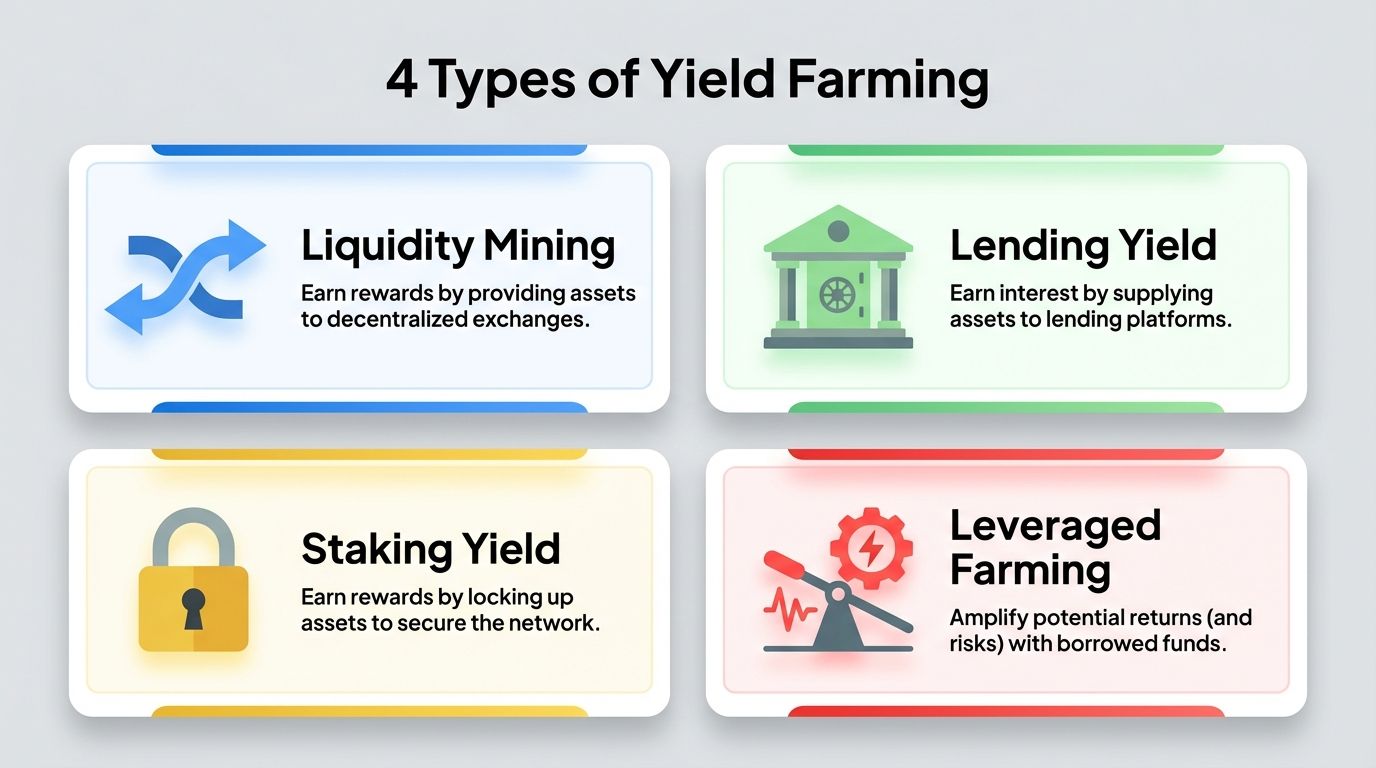
Yield farming is not a single strategy. There are several distinct models, each with different risk profiles and mechanics.
Liquidity Mining
This is the original yield farming model. You provide liquidity to a DEX (decentralized exchange) and earn trading fees plus additional governance or reward tokens issued by the protocol. Reward token emissions can inflate your returns significantly, but they can also dilute the token's value over time.
Lending and Borrowing Yield
Lending protocols allow you to deposit assets and earn interest from borrowers. This model is closer to traditional finance. Borrowers pay interest, lenders collect it. Some protocols layer additional reward token incentives on top. The yield is generally lower than liquidity mining but considerably more stable, since it does not depend on trading volume.
Staking Yield
Some protocols reward users who lock or stake tokens to support network security or governance. Staking yield is distinct from liquidity provision because you are not providing a trading pair, you are simply committing your tokens to the protocol. Returns tend to be more predictable, but tokens are often locked for a fixed period, reducing flexibility.
Leveraged Yield Farming
Advanced platforms allow users to borrow additional capital to amplify their yield farming position. By borrowing against deposited collateral, a farmer can increase exposure to a pool and potentially multiply returns. The risk is equally amplified. A price movement or liquidation event can wipe out a leveraged position faster than a simple LP position. This strategy is best reserved for experienced users who understand liquidation mechanics.
3. Best Yield Farming Platforms in 2026
The DeFi landscape has matured considerably. Several platforms have established track records and dominate total value locked (TVL) metrics going into 2026.
Uniswap
Uniswap remains the largest DEX by volume. Its concentrated liquidity model, introduced in V3, lets LPs allocate capital within specific price ranges. This can significantly increase capital efficiency and fee earnings, but it also requires active management. Positions that drift outside the selected range stop earning fees entirely.
Aave
Aave is the leading lending protocol across multiple chains. It supports a wide range of collateral types and has a robust risk framework. Depositors earn yield from borrower interest rates, which fluctuate based on utilization. Aave's safety module adds an additional staking option for token holders who want to contribute to protocol security in exchange for rewards.
Curve Finance
Curve is purpose-built for stablecoin and like-asset swaps. Its pools focus on assets with similar values, such as USDC, USDT, and DAI, or wrapped versions of the same asset like stETH and ETH. This design minimizes impermanent loss and makes it a preferred destination for conservative yield farmers.
Convex Finance
Convex is built on top of Curve. It allows Curve LPs to earn boosted rewards without having to lock governance tokens themselves. Convex pools together voting power and distributes enhanced rewards to depositors. For users who want Curve exposure without managing vote-locking, Convex is a popular solution.
Yearn Finance
Yearn automates yield farming through vaults. A vault accepts a specific token, then deploys a strategy to maximize returns by routing funds across multiple protocols. The strategy is managed by professional strategists, and the vault automatically reinvests earnings. For users who do not want to actively monitor and rebalance positions, Yearn offers a hands-off approach to yield optimization.
4. Risks of Yield Farming
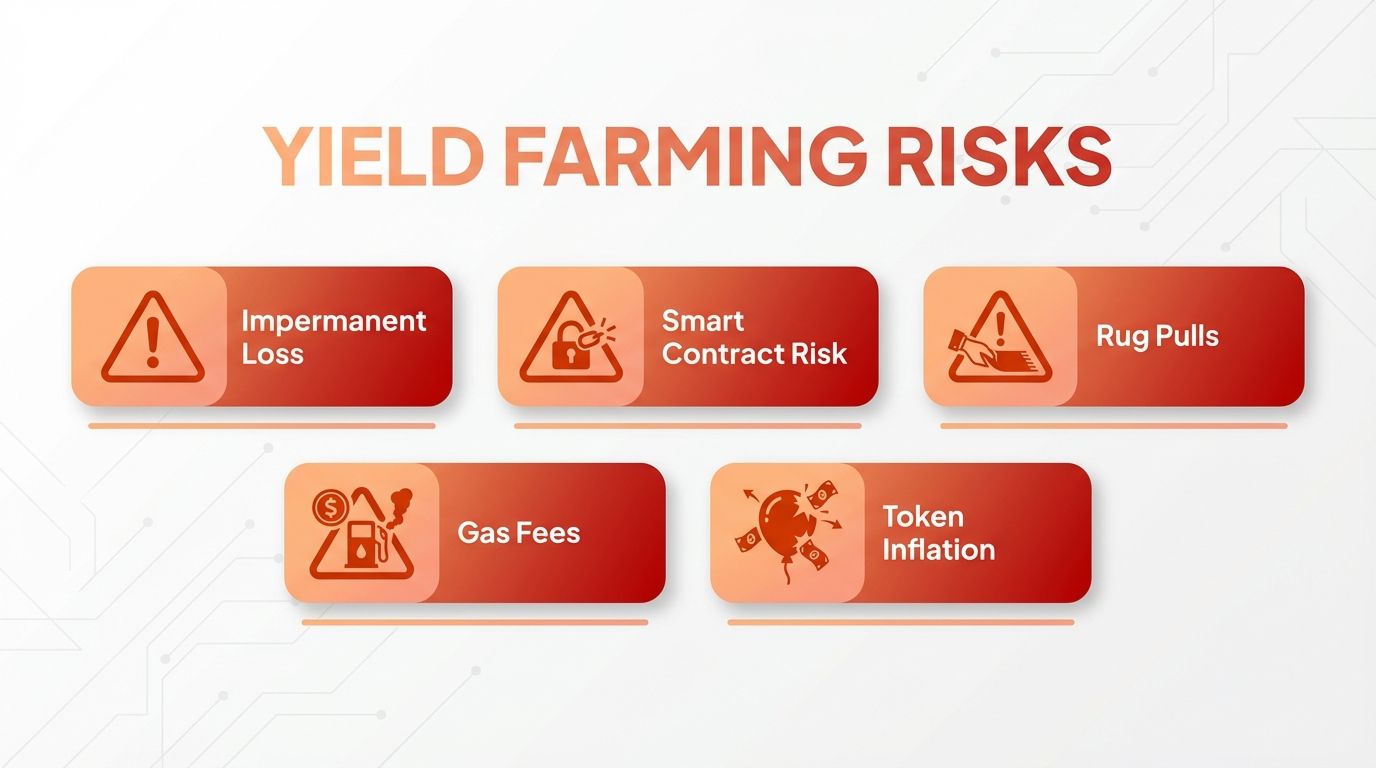
Yield farming carries real financial risks that every participant must understand before committing capital.
Impermanent Loss
Impermanent loss is the most commonly misunderstood risk in yield farming. When you deposit two tokens into a liquidity pool and the price ratio between them shifts, you end up with a different proportion of tokens than you deposited. If the price diverges significantly, the value of your position can be lower than simply holding the tokens. The loss is "impermanent" only if prices return to the original ratio, which is not guaranteed.
Smart Contract Risk
Every DeFi protocol runs on smart contracts. If a contract contains a bug or vulnerability, it can be exploited. Even audited protocols have suffered hacks. No audit is a guarantee of safety. Spreading capital across multiple protocols and avoiding very new or unaudited contracts reduces exposure, but does not eliminate it.
Rug Pulls and Exit Scams
In the longer tail of DeFi, anonymous teams can launch liquidity pools, attract deposits, and then drain the funds. Signs of risk include anonymous teams, unaudited contracts, unrealistically high APYs, and very short protocol history. Using platforms with long track records and transparent governance significantly lowers this risk.
Gas Fees
On Ethereum mainnet, gas fees for entering and exiting positions, claiming rewards, and compounding can consume a meaningful portion of smaller positions. This is less of a problem on Layer 2 networks like Arbitrum and Optimism, but it remains a factor to account for when calculating net yield. Always model gas costs into your return projections.
Token Inflation and Reward Dilution
Many protocols distribute native tokens as farming rewards. If those tokens are being continuously minted and sold by farmers, the price declines, reducing the real value of the yield. High APY numbers denominated in an inflationary token can be misleading. Focus on the dollar-denominated value of rewards and monitor emission schedules carefully.
5. How to Start Yield Farming Step by Step
Getting started with yield farming requires preparation. Rushing in without understanding the mechanics is one of the most common ways to lose capital.
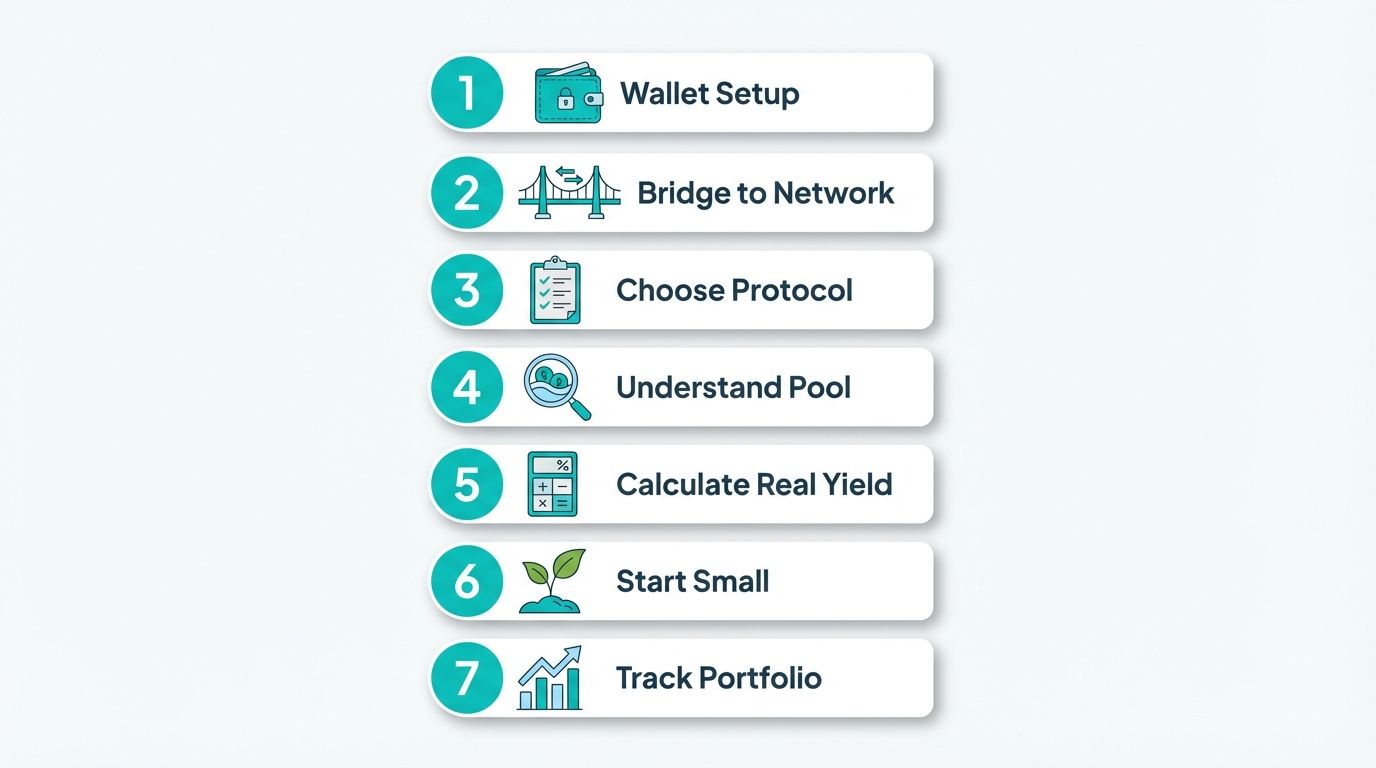
- Set up a non-custodial wallet. MetaMask, Rabby, or a hardware wallet like Ledger are standard options. Never use an exchange wallet for DeFi. You need full control of your private keys to interact with protocols.
- Bridge to your chosen network. Ethereum mainnet offers the deepest liquidity but the highest fees. Networks like Arbitrum, Base, and Optimism offer lower fees with access to the same major protocols. Use an official bridge or a reputable cross-chain aggregator to move funds.
- Choose a protocol based on your risk tolerance. Beginners should start with established platforms such as Aave for lending yield or Curve for stablecoin liquidity. Avoid protocols with anonymous teams, no audits, or launch dates measured in days rather than months.
- Understand the pool mechanics before depositing. Read the documentation for the specific pool you are considering. Know whether there is a lock-up period, what the reward token is, and what impermanent loss scenarios look like for the chosen asset pair.
- Calculate your real yield. Real yield equals fee income plus reward token income in USD, minus gas costs, minus impermanent loss estimate. Always model gas costs into your return projections before committing funds.
- Start small and monitor actively. Allocate only a portion of your portfolio to yield farming, especially when trying a new protocol. Check positions regularly, particularly for concentrated liquidity positions that can drift out of range.
- Track your portfolio with dedicated tools. Use a DeFi portfolio tracker to see all your positions, earned rewards, and net performance in one place. Knowing the full picture prevents surprises and helps you make informed rebalancing decisions.
Take Your DeFi Strategy Further with Altrady
Yield farming is one piece of a broader crypto strategy. Knowing when to enter and exit positions, how markets are moving, and how your overall portfolio is performing are all factors that directly affect your farming returns.
Altrady is a professional crypto trading platform that helps you track markets across multiple exchanges, manage your portfolio in real time, and execute trades with precision. Whether you are monitoring the price action of assets in your liquidity pools or looking to capitalize on market movements, Altrady gives you the tools to act on data, not guesswork.
Start with a free trial and see how a unified trading dashboard can sharpen your DeFi and trading strategy. No commitment required, just better visibility into your crypto activity from day one.
Frequently Asked Questions
What is the difference between yield farming and staking?
Staking typically involves locking a single token to support a network's proof-of-stake consensus or a protocol's governance mechanism. Yield farming is broader and often involves providing liquidity with multiple tokens, using LP tokens across multiple protocols, or combining lending, borrowing, and reward token strategies to maximize returns. Staking is generally simpler and lower risk, while yield farming can involve multiple layers of complexity.
Is yield farming still profitable in 2026?
Yes, yield farming can still be profitable, but the easy gains of 2020 and 2021 are largely gone. Sustainable returns in 2026 tend to come from real protocol revenue such as trading fees and lending interest, rather than inflationary token emissions. Strategies focused on stablecoin pairs and established protocols offer more predictable, if lower, returns compared to speculative high-APY pools.
How do I avoid impermanent loss?
The most reliable way to reduce impermanent loss is to provide liquidity in pools where the paired assets track each other closely. Stablecoin-to-stablecoin pools or correlated asset pools experience minimal price divergence and therefore minimal impermanent loss. If you are providing liquidity to volatile pairs, you need to ensure that trading fee income and reward tokens more than compensate for the potential loss.
What is a realistic APY for yield farming?
In 2026, realistic and sustainable APYs for established protocols range from 3% to 15% for stablecoin strategies and from 8% to 30% for volatile asset pairs on major platforms. Anything significantly above these ranges is either paying rewards in an inflationary token, carrying elevated smart contract risk, or involves leverage. Triple-digit APYs should always be investigated carefully before depositing funds.
Can I do yield farming with a small amount of capital?
On Ethereum mainnet, gas fees make small positions economically unviable. Layer 2 networks and alternative chains like Arbitrum, Base, Polygon, and Solana have dramatically lower fees, making yield farming accessible with smaller capital. Starting on a Layer 2 version of a major protocol is generally the most cost-effective entry point for smaller portfolios.